
Gov. Kelly Ayotte’s push for New Hampshire to embrace advanced nuclear technology places the state at the center of a renewed debate over the region’s energy future. The bipartisan call from New England’s governors last week to champion existing nuclear plants while pursuing next-generation reactors underscores the perceived urgency of reducing carbon emissions—but the unresolved question of nuclear waste storage looms over these ambitions. The U.S. Nuclear Waste Policy Act of 1982 mandates that spent fuel be isolated for at least 10,000 years, a timeline that stretches far beyond the practical reach of current policy. Yet the law’s requirement for a centralized national storage system remains unfulfilled, leaving states like New Hampshire to grapple with the consequences of nuclear generation without a clear solution for its most hazardous byproduct.
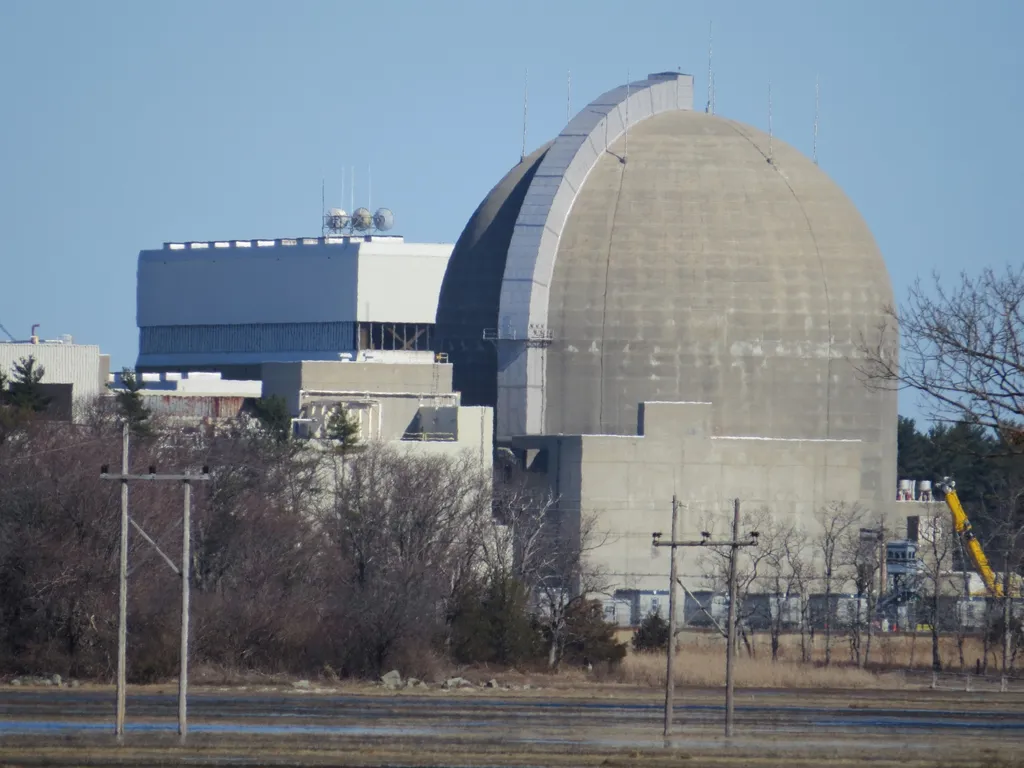
In New Hampshire, the issue is not theoretical. The Seabrook Station nuclear power plant, operating since 1990, continues to produce spent fuel stored on-site in steel-and-concrete casks, a temporary measure that defers the problem rather than solving it. The storage systems in use meet government standards for extreme weather resistance, but their long-term viability is untested. Meanwhile, spent fuel remains dangerously radioactive for millennia, with the International Atomic Energy Agency noting that the period of “greatest concern” spans roughly 10,000 years—a window in which geological stability and institutional memory cannot be guaranteed. “There have been efforts over several decades here in New Hampshire to raise attention to this issue, but obviously, we haven’t seen much real movement,” said Doug Bogen, executive director of the Seacoast Anti-Pollution League. For activists like Bogen, the absence of a national waste strategy renders the state’s nuclear ambitions premature.
The state’s history with nuclear waste proposals is fraught with contention. In the 1980s, the U.S. Department of Energy targeted western New Hampshire’s granite plutons—geological formations ideal for radiation containment—as potential sites for a deep underground storage facility. The plan would have displaced residents in Hillsborough and surrounding towns through eminent domain. Opposition erupted quickly. The Clamshell Alliance, alongside local and regional groups, mobilized protests and organized town warrant articles opposing nuclear waste storage, with 137 municipalities voting in favor. “There weren’t any Yankees that were going to take that,” recalled Paul Gunter, a founding member of the Clamshell Alliance. Their resistance was rooted in health, safety, and proliferation concerns, as well as deep skepticism about the federal government’s ability to isolate radioactive waste for millennia. Though the DOE ultimately abandoned the plan, the episode left scars—and a lingering distrust in how nuclear waste is framed as a separate issue from nuclear power itself.
“Opposing the generation of nuclear waste went hand-in-hand with opposing its storage,” Gunter said. Yet today, the two issues are often treated as distinct, allowing the waste problem to recede in policy discussions even as nuclear energy gains new political momentum. New Hampshire’s high-level radioactive waste act, initially enacted to block storage facilities, was quietly repealed in 2011. A later effort by former Rep. Renny Cushing to reinstate protections failed in 2020. The state’s evolving stance reflects broader national uncertainty. While Yucca Mountain in Nevada represented the closest the U.S. has come to a permanent solution, political opposition and regulatory hurdles derailed the project. The Biden administration has not revived it, and the Department of Energy has pivoted toward a new framework: “nuclear lifecycle innovation campuses” that would colocate fuel fabrication, enrichment, and waste disposition in a single federal-state partnership. The initiative, touted during the Trump administration, invites states to submit “statements of interest” for hosting such sites, with dozens of responses reportedly filed by the April 1 deadline. Whether New Hampshire has engaged remains unclear, as the state’s energy department did not immediately respond to inquiries.
For now, Seabrook Station’s spent fuel continues to pile up in dry casks on a concrete pad, a stopgap measure that offers no long-term resolution. The Nuclear Regulatory Commission and plant operators maintain that current storage methods are safe and compliant with federal standards. Yet the absence of a national plan leaves communities like those in New Hampshire—now being asked to consider new nuclear investments—grappling with a fundamental question: How can a state embrace nuclear energy’s future when its past and present waste remains unmanaged? The silence from Washington on a permanent solution suggests the problem has been deferred, not solved. And in a region where granite once promised safety, the weight of history—and radioactivity—remains unsettled.