
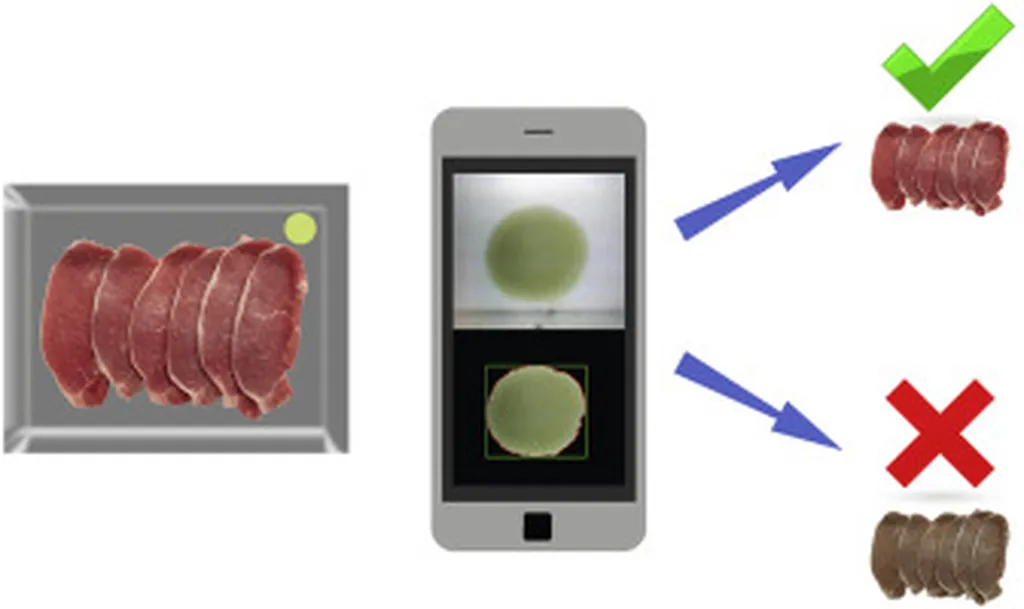
In a breakthrough that could redefine how perishable foods are monitored during storage and transport, researchers have developed a low-cost, real-time freshness sensor for buffalo meat that changes color as spoilage progresses. The innovation, led by Mohan Midhun (affiliation not disclosed), uses bromothymol blue (BTB) immobilized on paper strips to visually signal meat quality under modified-atmosphere refrigeration—a common commercial practice in the global meat supply chain.
The technology is deceptively simple: a small paper strip coated with BTB is placed inside the meat packaging. As the meat spoils, it releases volatile compounds like ammonia and other basic gases. These interact with the BTB, causing a visible color shift from yellow to green and eventually bluish-green over several days. This color change isn’t just aesthetic—it’s directly tied to measurable spoilage indicators.
“What excites me is that we’ve created a system that’s both scientifically robust and commercially practical,” Midhun said. “The strip responds within minutes to ammonia levels typical of spoiling meat, giving processors and retailers an immediate visual cue.”
The sensor’s color transitions align closely with key spoilage metrics: total viable microbial counts, total volatile basic nitrogen (TVBN), and pH levels. For example, the first noticeable color change occurs when microbial loads reach about 3 log CFU per gram—well before the meat becomes unsafe, but early enough to prevent waste. By day nine, when the strip turns bluish-green, the meat shows clear signs of spoilage with microbial counts exceeding 6 log CFU/g and TVBN levels near 18 mg per 100g—matching the point at which consumers would reject the product.
This isn’t just about food safety—it’s about energy efficiency and sustainability in the cold chain. Modified-atmosphere packaging (MAP) is widely used to extend shelf life, but current monitoring relies on periodic lab testing or subjective sensory evaluation. That means refrigeration units often run at full capacity longer than necessary, consuming excess energy.
With a real-time, on-pack indicator, storage conditions could be dynamically adjusted based on actual spoilage progression—not just preset timelines. A sensor that turns green could trigger a slight temperature adjustment or prioritize distribution, reducing unnecessary energy use in large-scale cold storage facilities.
The study, published in the *Journal of Veterinary and Animal Sciences* (formerly known as the *Indian Journal of Veterinary and Animal Sciences*), demonstrates that the BTB strip remains stable, doesn’t bleed dye, and responds reliably under commercial storage conditions (4°C with a gas mix of 30% CO₂, 20% O₂, and 50% N₂).
For the energy sector, this innovation could be a game-changer. Cold storage is one of the most energy-intensive segments of the food supply chain. According to the International Institute of Refrigeration, refrigeration accounts for about 40% of total energy use in food processing and preservation. If even 10% of facilities could optimize storage based on real-time spoilage data, the energy savings could be substantial—potentially reducing carbon footprints without compromising food safety.
While the current study focuses on buffalo meat (carabeef), the underlying principle—using pH-sensitive dyes to detect spoilage gases—could be adapted for other proteins, seafood, or even dairy. The next frontier might involve integrating such sensors with IoT-enabled logistics platforms, creating a fully automated, data-driven cold chain.
Midhun and his team have shown that sometimes, the best solutions aren’t the most complex—they’re the ones that work in real time, with minimal infrastructure. In a world where food waste and energy waste often go hand in hand, a strip of paper might just be the thin green line between spoilage and sustainability.