
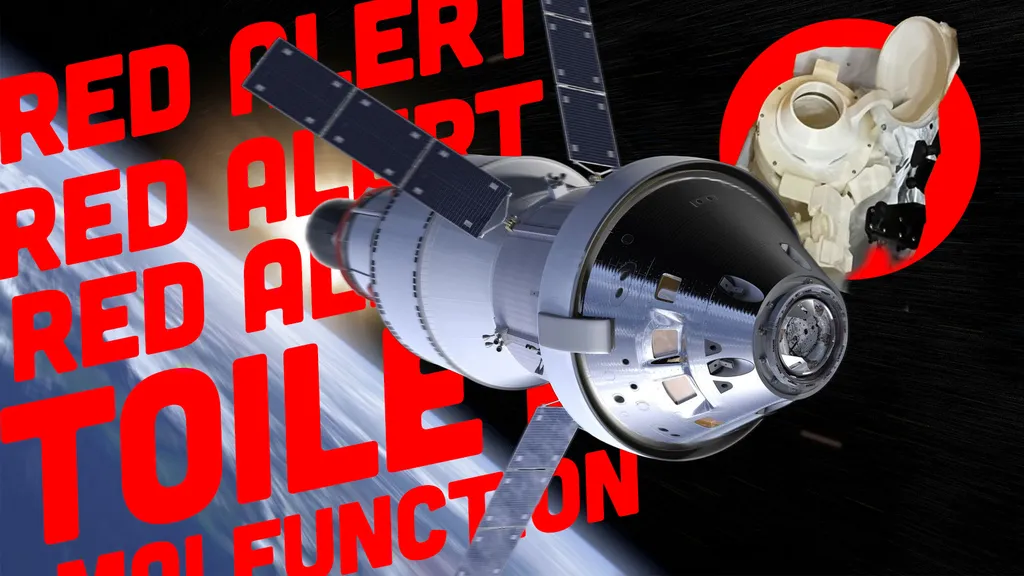
The malfunctioning toilet aboard NASA’s Orion spacecraft during the Artemis II mission underscores a critical, often overlooked challenge in deep space travel: waste management. While the $23 million Universal Waste Management System (UWMS) has faced two distinct failures—a pump issue requiring extra water and a wastewater dump clogged by ice—the problems were temporary and manageable. Yet the incident highlights how far human spaceflight still has to go before long-duration missions, like a journey to Mars, become feasible.
The UWMS, the first deep-space toilet of its kind, uses airflow to separate waste from the body in zero gravity. Astronauts secure themselves with foot restraints and handholds, while solid waste is stored in sealed bags and urine is collected in collapsible urinals when the system falters. The contingency measures—diapers and urinals—are reminiscent of the Apollo era, when astronauts dealt with floating waste disasters, as famously documented in Apollo 10 transcripts. “Give me a napkin, quick,” commander Tom Stafford radioed, capturing the awkward, human side of early space travel.
But the Artemis II mission signals progress. The UWMS was first deployed on the International Space Station in 2020, and while still experimental, it represents a leap from the Skylab station’s rudimentary toilet introduced in 1973. NASA Administrator Jared Isaacman acknowledged the system’s limitations on CNN, calling it “almost a bonus capability” and stressing the need for refinement. “We can do a lot of extraordinary things in space right now, but nailing this capability is one that we need to certainly work on,” he said.
The stakes are high. A Mars mission could take seven to ten months, demanding a toilet system that not only functions reliably but also potentially recycles waste. Jim Broyan, a deputy program manager at NASA’s Johnson Space Center, outlined future goals in 2020: stabilizing and drying metabolic waste to make it microbially inactive, reusing water from waste, and reducing consumables. “Can we reuse some of the waste?” he asked, hinting at a closed-loop system essential for sustainability beyond Earth.
The Artemis II toilet troubles might seem trivial, but they reveal a deeper truth: human space exploration is as much about engineering life-support systems as it is about propulsion. Until waste management becomes as routine as oxygen recycling, the dream of extended lunar stays or Mars colonies remains tethered to Earth’s conveniences. The moon is just the first proving ground—Mars, with its longer travel times and no quick return, will demand perfection.