
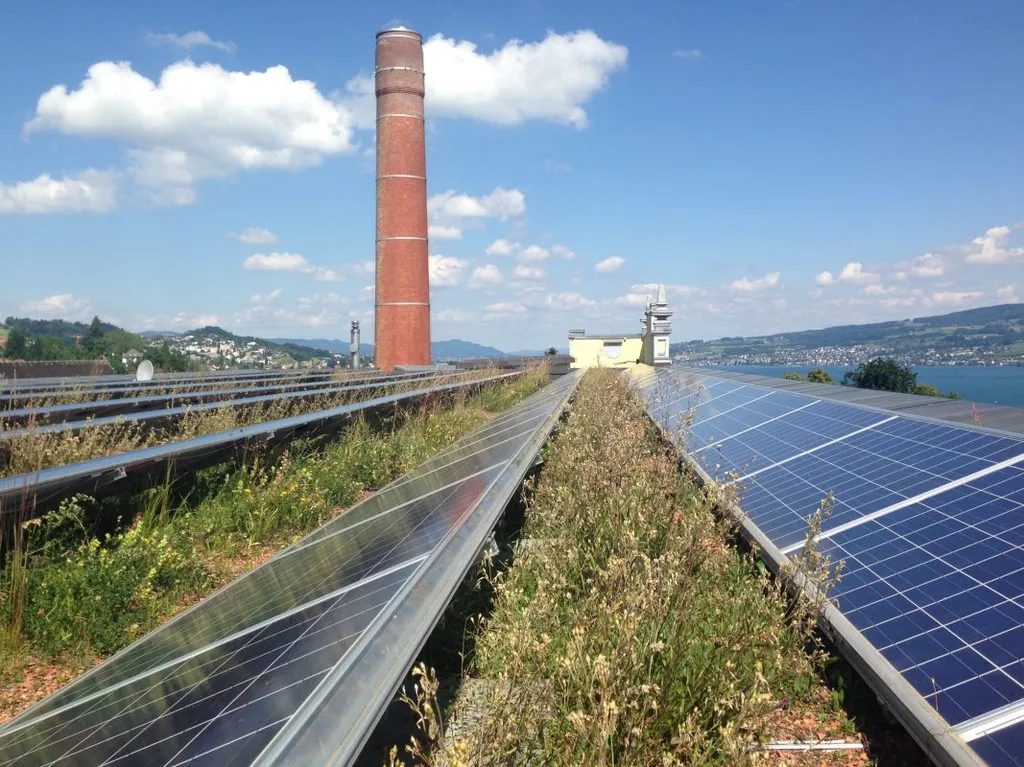
In the sun-baked hills of southern Italy, where summer temperatures can turn rooftops into ovens, researchers have uncovered a promising solution to two of urban development’s biggest challenges: energy efficiency and water conservation. Behrouz Pirouz, a researcher at the University of Calabria in Rende, has led a study that could redefine how cities approach sustainable building design, particularly in Mediterranean climates. The findings, published in the *Journal of Sustainable Development of Energy, Water and Environment Systems* (often referred to as JSDEWES in academic circles), suggest that integrating solar panels with green roofs—dubbed “bio-solar green roofs”—could significantly reduce both energy consumption and water use while improving urban resilience.
The experiments, conducted in Rende’s Mediterranean climate, compared conventional green roofs with bio-solar green roofs, which combine vegetation with photovoltaic panels. The results were striking. Pirouz and his team found that soil surface temperatures on bio-solar green roofs were consistently 4.8°C to 9.8°C lower than on conventional green roofs. Even bare soil showed this trend, hinting at the broader cooling effect of the integrated system. “The synergy between the solar panels and the green roof creates a microclimate that not only protects the vegetation but also enhances the efficiency of the panels themselves,” Pirouz explains. “It’s a win-win for energy and water management.”
Water savings were another major highlight. The study revealed a 41.2% reduction in irrigation needs for bio-solar green roofs compared to traditional green roofs. On the third day of monitoring, relative humidity in conventional green roofs plummeted from 97.7% to 32.5% by noon—far below the 40% threshold required for succulent plants. In contrast, bio-solar green roofs maintained humidity levels above 73.7%. This isn’t just about keeping plants alive; it’s about reducing the strain on urban water supplies, a critical issue as climate change intensifies droughts in many regions.
For the energy sector, the implications are particularly compelling. Solar panels lose efficiency as temperatures rise, a well-documented challenge in hot climates. By lowering the ambient temperature around the panels, bio-solar green roofs could improve their performance by up to 15%, according to some industry estimates. “This isn’t just about green infrastructure anymore,” says Pirouz. “It’s about leveraging nature-based solutions to make renewable energy systems more viable in the places where they’re needed most.”
The research comes at a time when cities worldwide are under pressure to meet sustainability targets. The European Union’s Green Deal, for example, mandates that all new buildings must be nearly zero-energy by 2030. Bio-solar green roofs could play a key role in meeting these goals, especially in Mediterranean regions where water scarcity and high temperatures collide. Policymakers are already taking notice. The study’s outcomes are expected to inform urban planning strategies, with potential applications ranging from commercial buildings to residential complexes.
What makes this study particularly groundbreaking is its practical approach. Unlike many theoretical models, Pirouz’s team conducted real-world experiments, measuring temperature, humidity, and irrigation cycles over time. Their work suggests that bio-solar green roofs aren’t just a theoretical advantage—they’re a scalable solution with measurable benefits. As cities look for ways to adapt to climate change while transitioning to renewable energy, innovations like these could bridge the gap between ambition and implementation.
The next steps? Scaling up. Pirouz and his team are already exploring how bio-solar green roofs perform in different climates and with various plant species. They’re also investigating the long-term durability of the systems, including how solar panels and vegetation interact over decades. For urban planners, developers, and energy providers, the message is clear: the future of sustainable cities may lie in the seamless integration of technology and nature. And in places like Rende, where the sun is both a blessing and a challenge, that future might arrive sooner than we think.