
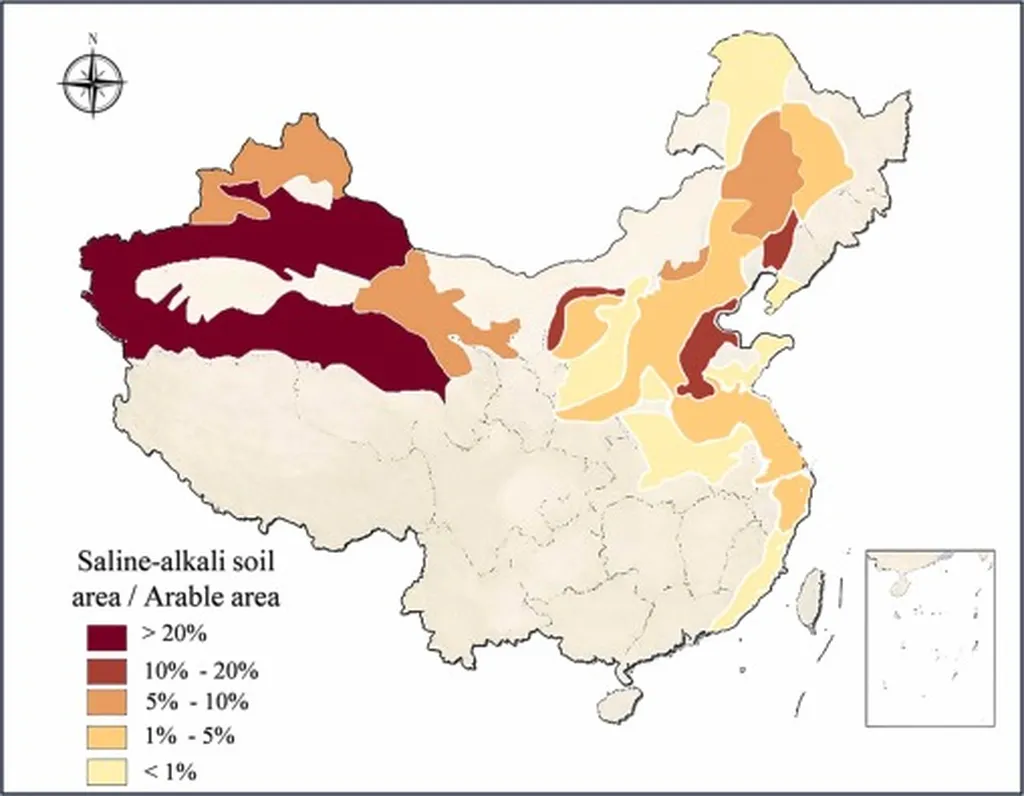
In the salt-crusted flats of China’s coastal regions, where the land is too harsh for most crops and even tough grasses struggle to take root, a team led by Zhaoqiang Ju of the Center for Agricultural Resources Research has cracked a stubborn problem. Their integrated technology doesn’t just reclaim saline soil—it transforms it into land capable of supporting vegetation with a survival rate exceeding 94%. For industries eyeing coastal land for energy infrastructure, agriculture, or carbon capture, this could mean the difference between barren ground and productive real estate.
The breakthrough hinges on a three-pronged approach: amending the soil with corn straw to cut salinity, installing subsurface drainage pipes at 80 centimeters to flush out salts, and using freezing saltwater irrigation to draw salinity downward. “We’re not just treating the symptoms,” Ju explains. “We’re restructuring the soil’s salt balance from the ground up.”
For energy developers, the implications are immediate. Coastal sites slated for solar farms, wind turbine foundations, or hydrogen production often face prohibitive soil conditions. Salt buildup corrodes metal and concrete, undermines foundations, and prevents revegetation—critical for erosion control and ecological compliance. Ju’s method offers a scalable, low-energy alternative to energy-intensive desalination or deep tillage. “Instead of hauling in fresh water or importing topsoil, we’re using what’s already here—saltwater and agricultural waste—to fix the land,” he adds.
Early field trials showed topsoil salinity dropping below 5.0 g/kg—within thresholds tolerable for salt-tolerant plants like Suaeda salsa and Spartina alterniflora. Subsurface pipe drainage at 80 cm proved most effective under local conditions, enabling continuous salt removal even during monsoon seasons. Freezing saltwater irrigation, a counterintuitive twist, leverages winter temperatures to create salt gradients that pull brine downward, reducing surface salt accumulation.
“This isn’t just about greening the coast,” says Ju. “It’s about securing stable footprints for energy projects in areas where land was previously unusable.” Published in *Applied and Environmental Soil Science* (translated from *Yingyong yu Huanjing Tudi Kexue*), the study offers a template for coastal restoration that could ripple across Asia, the Middle East, and the Americas—where saline soils cover millions of hectares.
As climate change intensifies coastal flooding and saltwater intrusion, technologies like this one may become as vital to energy infrastructure as transformers and turbines. The next frontier? Scaling the system for larger tracts, integrating remote sensing to monitor salt dynamics, and adapting the method for brackish aquaculture ponds. One thing is clear: the ground beneath our feet is getting saltier, but with innovations like Ju’s, it doesn’t have to stay that way.