
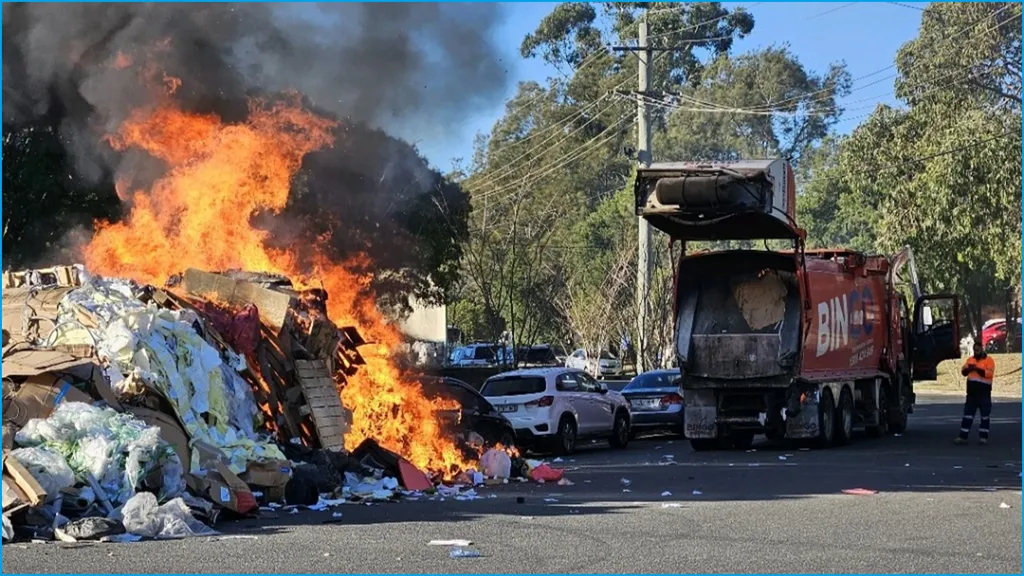
The first commercial deployment of Full Circle Lithium’s FCL-X™ to a major U.S. waste management operator signals a shift in how industry is confronting lithium-ion battery fires. Unlike traditional suppression methods—water, soil smothering, or isolation—which struggle against thermal runaway, FCL-X™ targets the chemical reaction itself, reducing reignition risk and providing a safer environment for on-site crews. The urgency of this shift is underscored by recent incidents: in Edmonton, a single lithium-ion battery fire caused $2.5 million in damage with temperatures hitting 2,000°C; in Oregon, a landfill recorded 21 such fires in just three months. These aren’t isolated anomalies but part of a systemic challenge. Over 5,000 fires occur annually at North American recycling facilities, many linked directly to undetected lithium-ion batteries entering the waste stream.
Carlos Vicens, CEO, frames this sale as more than a product milestone—it’s a market inflection point. “Waste operators are facing a growing and costly threat with no effective solution, until now,” he stated. The scale of the problem is now too large to ignore. Traditional firefighting methods fail because lithium-ion battery fires are not conventional combustion; they’re sustained chemical reactions releasing toxic gases and capable of reigniting hours or days later. Water can exacerbate the situation by spreading conductive electrolytes, while isolation strategies are impractical at industrial processing speeds. FCL-X™, a proprietary water-based agent, is engineered to penetrate waste piles, neutralize thermal runaway, and suppress reignition without introducing new hazards.
For waste management operators, this sale represents more than a one-off purchase—it signals the emergence of lithium-ion fire suppression as a core operational requirement. Insurers are already recalibrating risk models, regulators are tightening standards, and facility managers are reassessing emergency response protocols. The financial implications are stark: the $2.5 million Edmonton incident is not an outlier but a preview of what’s to come as e-bikes, power tools, and portable electronics proliferate. With over 2,400 waste facility fires estimated across the U.S. and Canada in 2022 alone, the cost of inaction now outweighs the investment in prevention.
The commercialization of FCL-X™ also exposes a deeper infrastructure gap: the inability to detect lithium-ion batteries within fast-moving mixed waste streams. Current screening technologies lag behind the proliferation rate of these devices. Until detection systems improve, suppression must take precedence. This creates a clear path for FCL to scale from specialized extinguishing agent to industry standard, particularly as electrification accelerates and second-life batteries enter the waste stream.
What remains uncertain is whether this marks the beginning of rapid sector-wide adoption or a cautious, case-by-case rollout. Early adopters will likely face scrutiny over efficacy and cost, especially as larger, better-capitalized competitors eye the same opportunity. Yet the data is increasingly undeniable: lithium-ion battery fires are not a passing concern but a persistent, escalating crisis. The sale to a major operator suggests that the waste management industry is ready to treat this threat with the same urgency as structural fire safety. The question now is how quickly the rest of the sector will follow.