
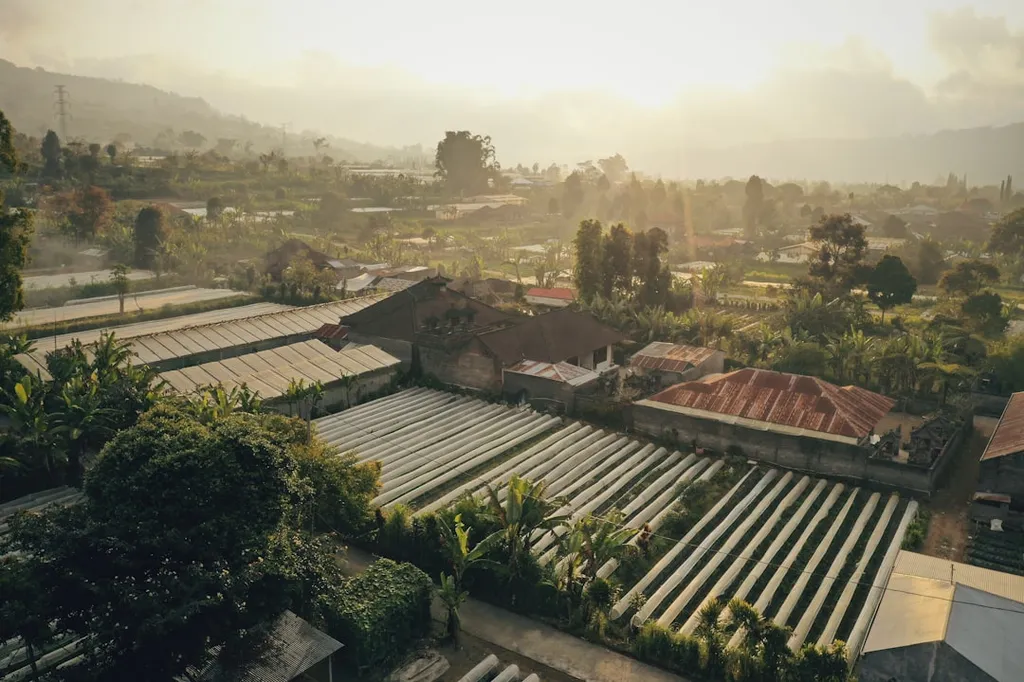
The greenhouse in Bandar Lampung, Indonesia, isn’t much to look at from the outside—a simple structure of plastic sheeting and metal frames. But inside, where Dani Rofianto and his team from Politeknik Negeri Lampung have installed their IoT-based smart irrigation and fertilization system, the difference is striking. Sensors hum softly, relaying real-time data to a cloud database, while automated valves adjust water flow and fertilizer distribution with a precision that manual methods simply can’t match. “We’re not just saving water,” Rofianto explains. “We’re making every drop work harder—and that changes the economics of small-scale farming.”
The system, published in the *National Journal of Electrical Engineering and Information Technology* (Jurnal Nasional Teknik Elektro dan Teknologi Informasi), combines off-the-shelf sensors with an ESP32 microcontroller to create a closed-loop control environment. Soil moisture, air humidity, and temperature readings are streamed to Firebase’s Realtime Database, where they’re processed to trigger irrigation and ventilation adjustments. During testing, the system maintained greenhouse conditions within tight tolerances: 27.91°C, 74.75% relative humidity, and 71.31% soil moisture, all within ±2.3% of analogue measurements. Relay responses clocked in under a second, and Firebase synchronization topped 98% reliability—even in areas with spotty connectivity.
What makes this more than just another tech demo is the commercial impact. By automating irrigation and fertilization, the system reduced water usage by 20% compared to traditional methods. For energy-intensive sectors like agriculture, where pumping and treatment account for a significant share of operational costs, that kind of efficiency isn’t just incremental—it’s transformative. “Farmers aren’t just saving water,” says Rofianto. “They’re cutting energy bills, reducing labor, and improving yield stability. In regions where water is scarce and electricity is expensive, this isn’t optional—it’s necessary.”
The implications stretch beyond the greenhouse. The system’s ability to operate reliably with unstable internet suggests it could support decentralized, precision agriculture in remote or underserved areas. And with a responsive web dashboard allowing manual override, it bridges the gap between automation and real-world usability. The team is already eyeing next steps: integrating AI models like fuzzy logic or machine learning to make the system adaptive, not just reactive. “We’re building a platform,” Rofianto notes, “not just a tool. The goal isn’t just to react to conditions—it’s to predict them.”
For the energy sector, this research offers a glimpse into a future where water and power management are tightly coupled. Smart irrigation doesn’t just conserve water—it reduces the energy needed to pump, treat, and distribute it. In a world where climate variability and resource constraints are reshaping industries, innovations like this one could redefine efficiency standards. The question isn’t whether such systems will become mainstream, but how soon—and who will be first to scale them.