
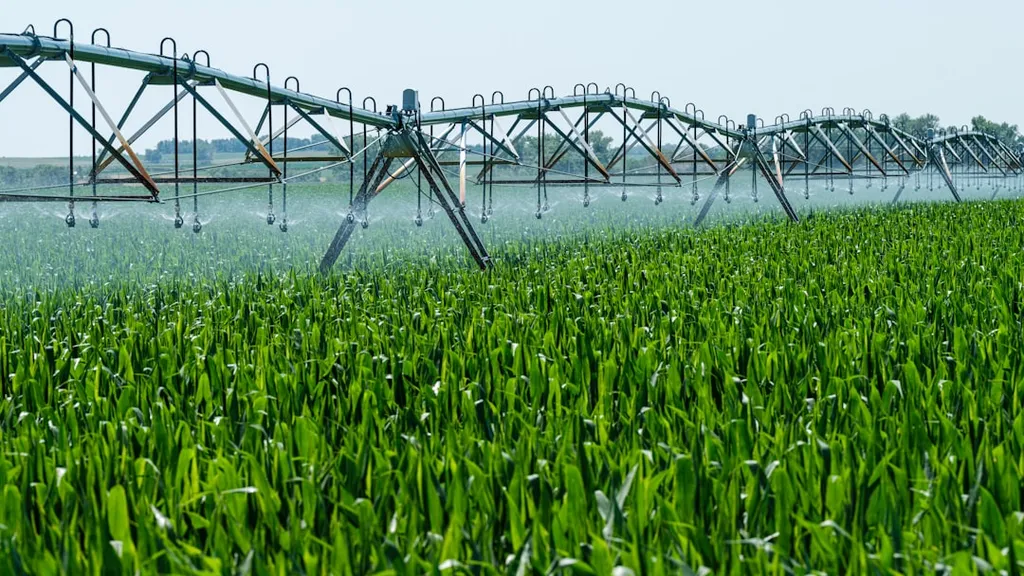
In a quiet revolution reshaping China’s agricultural landscape, researchers led by Zhang Lu, Sun Wen-xuan, Wang Xiu-ru, and Liu Li-bing have uncovered how automatic control technology is transforming water-saving irrigation from a promising concept into a commercial reality. Their analysis, published in *Soil and Water Conservation Research* (Shuitu baochi yanjiu), examines not just the technology itself but its economic ripple effects across energy and water sectors—an angle often overlooked in broader discussions of sustainable farming.
The team’s findings underscore a shift from labor-intensive irrigation methods to precision-driven systems where sensors, central control units, and automated valves work in concert. “The integration of real-time data collection with adaptive irrigation scheduling is not just about saving water—it’s about optimizing energy use across the entire agricultural supply chain,” says Zhang Lu, lead author of the study. That’s a critical insight for energy planners, as water pumping typically accounts for 20–30% of electricity consumption in irrigation-heavy regions.
One standout case analyzed in the paper involves a large-scale wheat farm in northern China, where a central control system linked soil moisture sensors to a remote irrigation network. By adjusting water flow based on evapotranspiration forecasts and field conditions, the system reduced water use by 25% and cut electricity demand by 18% during peak growing seasons. Such efficiency gains translate directly into lower operational costs and reduced strain on regional power grids—especially during droughts when irrigation demand spikes coincide with reduced hydropower output.
The authors also map out the technology stack behind these systems: from low-cost IoT sensors that monitor soil tension and weather data, to cloud-based platforms that integrate with existing farm management software. “We’re seeing a convergence of affordable hardware and open-source analytics,” notes Liu Li-bing, a co-author affiliated with a leading agricultural technology institute. “This is democratizing access to high-efficiency irrigation for smallholders, not just large agribusinesses.”
What’s perhaps most compelling is the forward-looking analysis in the paper. The authors predict that as China pushes toward carbon neutrality by 2060, the energy-water nexus in agriculture will become a focal point for policy and investment. Automatic control systems could become eligible for green financing, carbon credit schemes, or even utility rebates—turning water savings into a tradable asset.
For energy professionals watching this space, the message is clear: the next wave of demand-side energy management may not come from smart thermostats or EV charging, but from fields where every drop of water saved is a watt of power retained. As Sun Wen-xuan puts it, “We’re not just irrigating crops anymore—we’re irrigating efficiency itself.”