
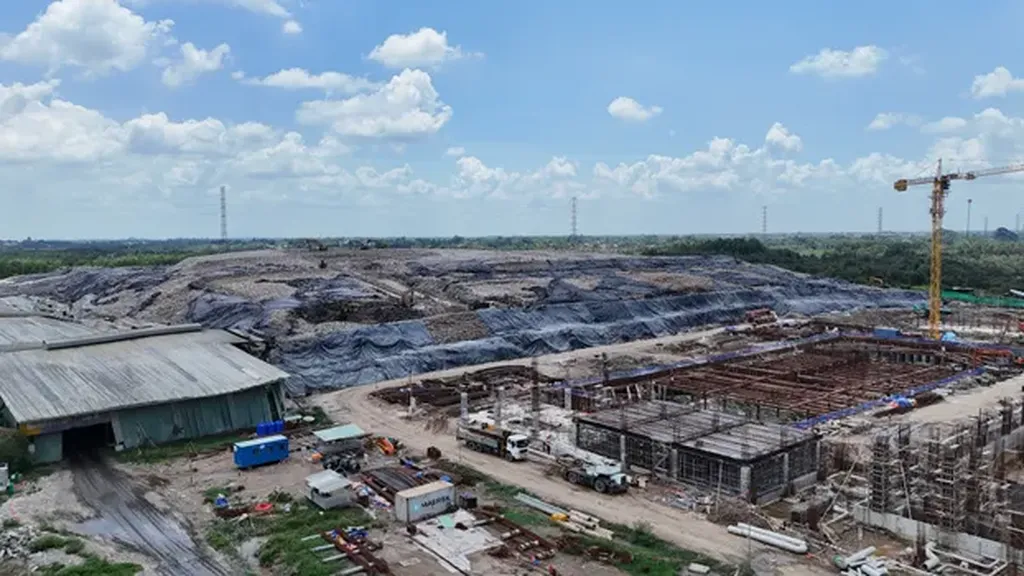
Vietnam Waste Solutions (VWS) is turning Ho Chi Minh City’s Da Phuoc landfill—once a straightforward burial site—into a multi-purpose resource-recovery hub, earmarking $200 million already spent on its environmental infrastructure as just the first phase of a much larger transformation. The facility, the country’s only landfill built to U.S. Subtitle D standards when it opened in the mid-2000s, now buries 2.4 million tons of municipal waste a year for more than half the city’s households. Its leachate treatment plant, gas-capture systems and engineered liners already set it apart from typical Vietnamese dumps, but the next step is to add a 50- to 60-megawatt waste-to-energy plant and specialized recycling lines. The goal is to cut the volume of material sent to final disposal while generating clean power and recovering recyclables, aligning with Vietnam’s 2050 net-zero pledge.
California Waste Solutions, the Oakland-based parent, frames the expansion as an extension of its long-standing “constantly improving on existing resources” ethos. Michael Duong, the company’s president, points to decades of incremental upgrades at Da Phuoc as proof that steady investment in environmental infrastructure can deliver more than compliance—it can create scalable solutions. “The renewable proposal is consistent with our core philosophy to be constantly improving on existing resources, both for the benefit of CWS and its subsidiaries and for our customers and the places they live in,” he said. The family-run business, which started collecting recyclables on Oakland’s streets, now insists on building assets that can be defended decades into the future, even when cheaper short-term options exist.
The transformation is not simply an energy play. Da Phuoc’s original design placed water at the center of operations. German firm Wehrle supplied the leachate treatment system, deploying biological processing, membrane filtration and reverse osmosis so the plant can reuse treated water for dust suppression, equipment washing and irrigation instead of drawing fresh groundwater. The company claims its effluent is cleaner than water in nearby waterways, a claim backed by internal monitoring data rather than third-party verification. The facility’s recycling lines, provided by Dutch equipment maker Bollegraaf, have been pulling commodities from the waste stream for years, while Austrian firm Komptech supplies organic-processing equipment for composting and soil amendments. These systems are now being supplemented with new sorting lines designed specifically for the waste-to-energy feedstock, ensuring that energy recovery targets only the fraction of waste that cannot be economically reused or recycled.
Electricity generation is already part of the site’s operations. VWS has captured landfill gas for years, converting decomposition gases into on-site power, but the proposed 50- to 60-megawatt plant will process residual municipal waste before final disposal, adding a second energy-recovery pathway. The landfill-gas system will continue to run in parallel, expanding rather than replacing an existing model. Construction and day-to-day operations will remain in Vietnamese hands, with VWS relying on contractors it has trained over the years, while CWS retains control of the energy systems.
The project’s scale and ambition make it a test case for Vietnam’s broader green industrial push. Da Phuoc is still the only landfill in the country built to U.S. Subtitle D standards, a design choice that many in the industry once dismissed as prohibitively expensive. David Duong, the founder and CEO of California Waste Solutions, defends the approach as necessary for durability. “We are all about quality as the main driver of everything we do,” he said. “At the end of the day, I want to stand by what I’ve committed to doing and say, ‘This is the absolute best anyone could have done.’ That’s really the goal of the company since our early days picking up trash on the streets of Oakland for recycling. It’s the same today.” The insistence on high-specification engineering, from leachate containment to gas capture, is now being extended into energy recovery and advanced recycling, signaling that the same philosophy can underpin Vietnam’s next generation of waste infrastructure.