
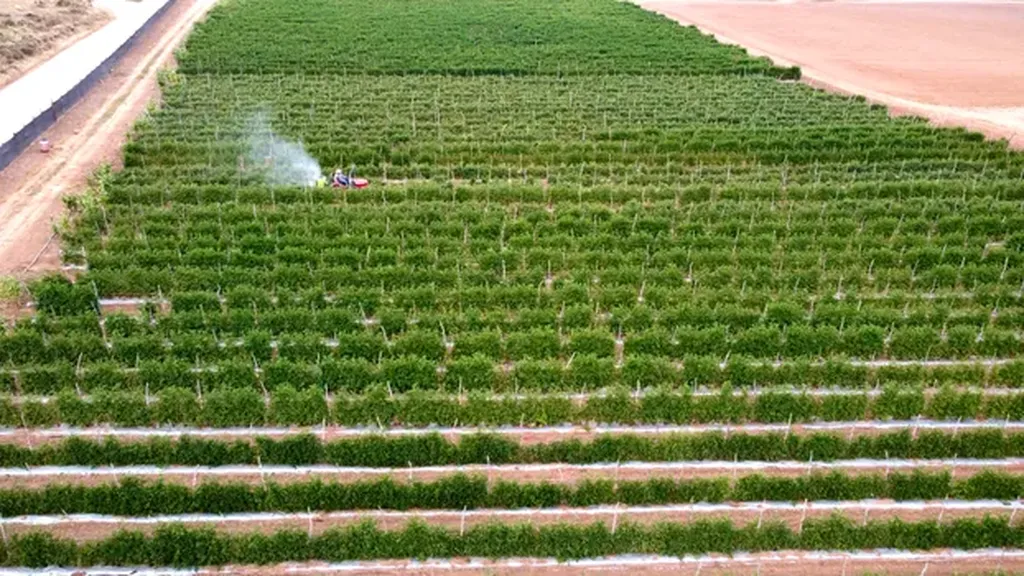
In the arid expanses of Xinjiang, China, where water is scarcer than gold, a breakthrough in agricultural irrigation could redefine how farmers—and the energy sector—approach water use in crop production. Researchers led by Zhecheng Jia of Shihezi University have demonstrated that smart irrigation strategies, tailored to both crop growth stages and annual rainfall patterns, can slash water use without sacrificing yield in processing tomatoes—a key cash crop in the region.
The study, published in *Agricultural Water Management* (Nóngyè Shuǐlǐ Guǎnlǐ in Chinese), leverages the DSSAT–CROPGRO–Tomato model, a sophisticated simulation tool that mimics how tomato plants respond to water stress at different growth phases. By calibrating the model with field data from 2019 and 2020, Jia’s team fine-tuned genetic parameters to predict tomato behavior under varying irrigation regimes. Their findings suggest that deficit irrigation—deliberately reducing water supply during less critical growth stages—can be optimized to save water without harming yield.
“Our results show that the right deficit irrigation strategy can reduce water use by up to 11% while keeping yield loss under 5%,” Jia explains. “This is especially true in wetter years, where we can push water savings further without risking production.”
The research goes a step further by classifying hydrological years based on seasonal rainfall—wet, normal, and dry—and simulating 50 different irrigation scenarios for each type. In wet years, moderate deficit irrigation during non-critical stages worked well, but in dry years, flowering and fruit expansion demanded more careful water management. The takeaway? One-size-fits-all irrigation is outdated. Farmers—and the energy systems that support them—need adaptive strategies.
For the energy sector, this has implications beyond the farm gate. Water pumping, treatment, and distribution are energy-intensive processes. If farmers can reduce irrigation by 7–11% without sacrificing yield, the ripple effects could include lower electricity demand for water infrastructure, reduced operational costs for agricultural cooperatives, and even potential carbon savings in regions where irrigation relies on fossil-fueled grids.
The study’s methodology—combining long-term weather data, crop modeling, and hydrological classification—offers a blueprint for other water-stressed regions. As climate variability intensifies, tools like DSSAT–CROPGRO could become indispensable in balancing food production with resource conservation.
For now, Jia’s team has shown that precision irrigation isn’t just a theoretical advantage—it’s a practical lever for sustainability. And in places like Xinjiang, where water scarcity is a daily reality, that could make all the difference.