
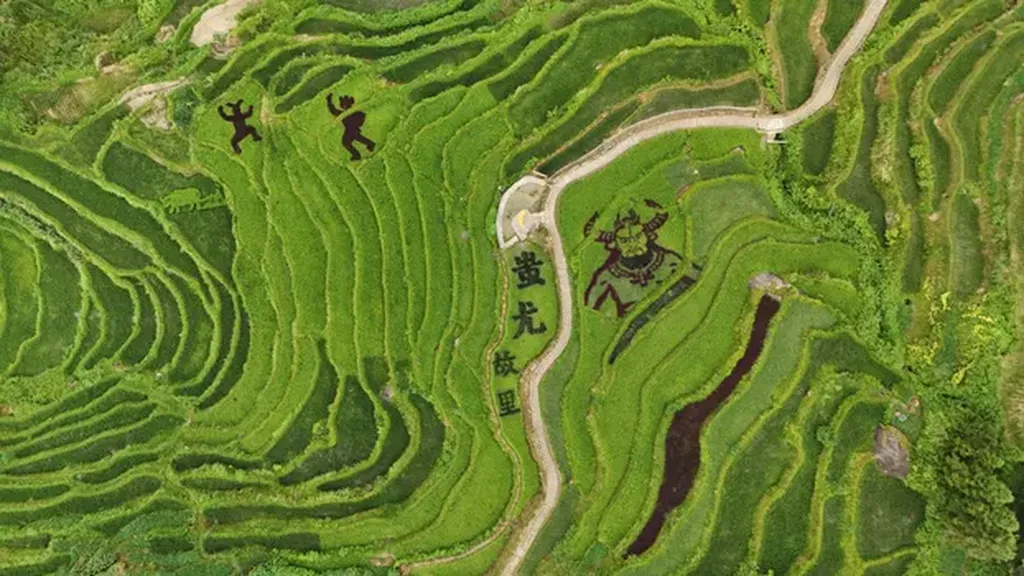
For decades, Hunan’s rice paddies have been the breadbasket of subtropical China, producing two harvests a year with a reliability that farmers took for granted. But now, the sky is changing. Since 1960, temperatures in Hunan have climbed steadily, while rainfall has become more erratic—long dry spells punctuated by sudden downpours that flood fields just as quickly as they parch them. These shifts aren’t just environmental footnotes; they’re reshaping the very rhythm of rice growth, and with it, the energy systems that power irrigation, processing, and transport across one of China’s most productive agricultural regions.
Rouyan Gong, a researcher at Hunan Agricultural University’s School of Water Conservancy and Civil Engineering, and The Hunan Engineering Technology Research Center of Precise Control Irrigation for Irrigation Districts, has spent years digging into the numbers. Using 62 years of weather data from 28 stations across Hunan, Gong and the team found that the old rules no longer apply. “We’re seeing a decoupling of water and heat that happens at very specific moments in the rice lifecycle,” Gong explains. “It’s not just that it’s hotter or drier—it’s that the timing is off. Water isn’t where it needs to be when the plant needs it most.”
The study, published in *Agricultural Water Management*, goes beyond broad climate trends. It introduces a new tool called the Stage-specific Rice Water Deficit Index (SRWDI), designed to measure water-heat mismatches during precise growth stages like transplanting, tillering, and panicle initiation. Unlike traditional models that treat the growing season as a single block, SRWDI zooms in on critical windows—often just days long—where a water shortage or heat spike can slash yields.
The results are stark. For mid-season and late rice, the most vulnerable periods are early growth (transplanting to tillering) and the transition to flowering (panicle initiation to booting). During these stages, even moderate water deficits can slash yields by over 40%. Gong’s team validated their model using rigorous testing, including a real-world stress test: the 2022 megadrought, which saw rainfall drop by nearly 30% across Hunan. The drought hit hardest during the transplanting-tillering window, triggering extreme SRWDI deficits that crippled regional production.
What does this mean for the energy sector? Irrigation systems in Hunan are powered largely by electricity and diesel, with pumps running on tight schedules tied to monsoon rhythms that no longer exist. As climate whiplash intensifies, energy demand for water management will become less predictable—spiking during dry spells and straining grids just as heatwaves drive up cooling loads. Farmers may need to irrigate earlier, more frequently, and with greater precision, shifting electricity use from mid-season to early season and increasing overall consumption.
“This isn’t just about saving water—it’s about saving energy,” says Gong. “If we can adjust irrigation timing based on phenology rather than calendar dates, we can reduce pumping during peak demand hours and avoid costly grid overloads during droughts.”
The implications ripple outward. Rice processing plants, logistics networks, and even fertilizer suppliers all depend on predictable harvests. A 20% yield drop in late rice doesn’t just mean less food—it means fewer truckloads on highways, lower demand for drying and milling, and potentially stranded energy assets if demand forecasts miss the mark.
Gong’s work suggests a future where water and energy systems are co-designed with rice phenology in mind. Smart irrigation scheduling, real-time soil moisture monitoring, and dynamic energy pricing could all become standard. The goal isn’t just to adapt to climate change—but to outpace it, one carefully timed drop at a time.
“This study shows we can’t rely on historical averages anymore,” Gong says. “The future belongs to systems that listen to the plants—and to the weather, in real time.”