
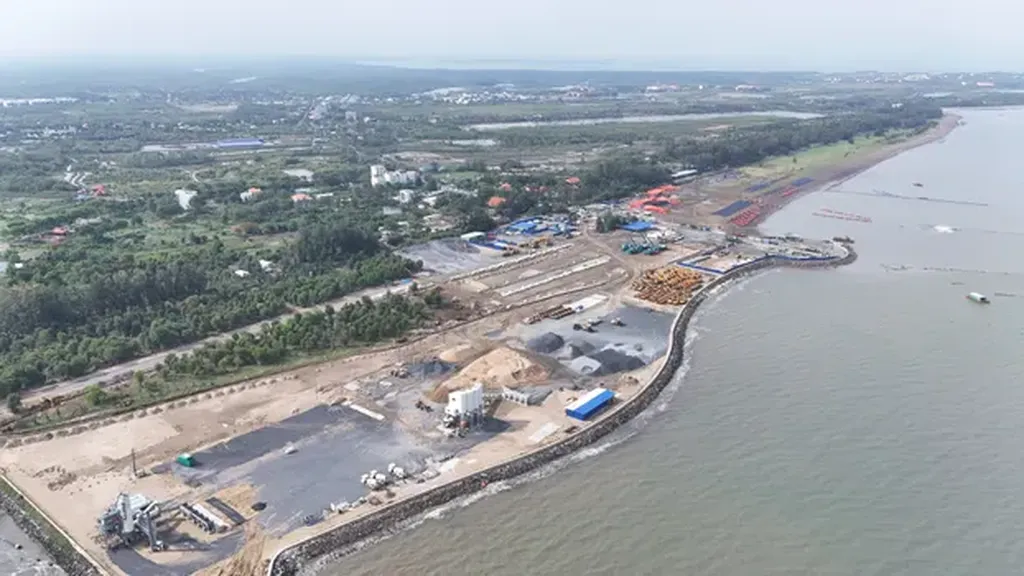
The steady hum of construction cranes along Vietnam’s coastline tells a familiar story of rapid urbanization, but the land beneath them is telling a more complex tale—one of shifting priorities, economic pressures, and environmental trade-offs. A new study published in *City and Environment Interactions* (Tạp chí Tương tác Thành phố và Môi trường) by lead author Bui Thi Thanh Huyen, from the Faculty of Planning and Development at the National Economics University in Hanoi, reveals how Vietnam’s coastal land is being transformed not just at the surface, but across distinct zones that respond differently to development forces.
Using high-resolution GIS data and panel regression models spanning 2017 to 2025, the research maps how land use evolves from the shoreline inland—dividing the coastal zone into three bands: 0–10 km, 10–20 km, and 20–30 km from the coast. What emerges is a picture of intense pressure right at the water’s edge, where urban expansion is most aggressive, and a transitional belt further inland where agriculture and natural vegetation are still in flux.
“Urban land continues to grow across all coastal gradients,” says Bui Thi Thanh Huyen, “but the rate and pattern differ sharply by distance from the sea.” The 0–10 km zone, closest to ports, tourism hubs, and industrial zones, shows the most dramatic shift: urban land is expanding relentlessly, while cropland is declining at the fastest pace. This is where investors, developers, and energy planners are most active—building resorts, power plants, and logistics infrastructure. The pressure is palpable.
Further inland, in the 10–20 km band, the study identifies a dynamic “transition belt” where cropland is being restructured into other uses or reverting to vegetation. This zone may offer a buffer—but it’s not a stable one. “Conversions between vegetation and cropland are more common here,” explains Bui, “suggesting land is being held in reserve or undergoing speculative changes pending future development.”
The commercial implications for the energy sector are significant. As urban areas expand, the demand for power rises, but so do constraints on land availability for new energy infrastructure. Offshore wind farms, solar parks, and transmission corridors all require space—and often compete with agriculture and aquaculture. The study suggests that nearshore zones (0–10 km) are already saturated with development, pushing energy projects further inland or offshore. Meanwhile, the transitional 10–20 km belt may become a key battleground for land-use negotiations, where planners, investors, and communities must balance short-term gains with long-term sustainability.
Population growth is a major driver, the study finds, with urban land share increasing in tandem with population density—though not in a straight line. The relationship is nonlinear, reflecting phases of rapid expansion followed by consolidation. Water bodies, by contrast, are more prevalent near the coast but shrink as populations grow, likely due to drainage, reclamation, or conversion to built-up land.
For energy companies eyeing Vietnam’s coastal growth, the message is clear: the coastline is not a uniform frontier. Land-use transitions are spatially differentiated, and understanding these gradients is essential for strategic planning. A solar farm may thrive in the 10–20 km zone today, but could face zoning changes tomorrow as urban sprawl advances. Meanwhile, nearshore areas are becoming premium real estate—expensive, contested, and environmentally sensitive.
Bui Thi Thanh Huyen’s work offers a gradient-based lens through which to view coastal development. It’s not just about building more—it’s about building smarter, with awareness of how each kilometer from the sea shapes the future of land, livelihoods, and energy systems. In a rapidly urbanizing Vietnam, the coast is more than a boundary. It’s a frontier of competing visions—and the choices made here will ripple across industries, ecosystems, and generations.