
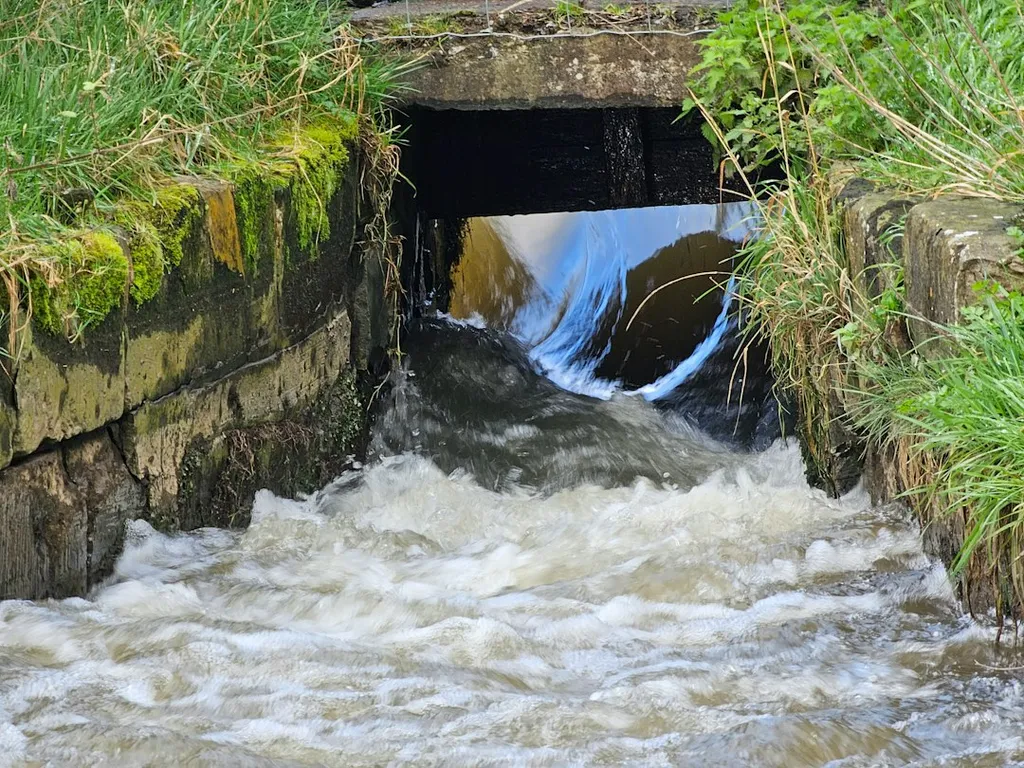
Q. Li and colleagues at the Southern Marine Science and Engineering Guangdong Laboratory (Zhuhai) and Sun Yat-Sen University have uncovered a critical nuance in how global streamflow reanalysis errors propagate from precipitation errors—one that could reshape how energy utilities, grid operators, and renewable developers plan for water availability.
Their analysis of 671 catchments across the U.S. using the Global Flood Awareness System (GloFAS) driven by ECMWF’s ERA5 reanalysis shows that streamflow reanalysis errors don’t scale uniformly with precipitation errors. Instead, they diverge dramatically depending on catchment type. In humid regions, a 1 mm increase in precipitation reanalysis error can translate into a 2.5 mm increase in streamflow error. But in arid catchments, the same precipitation error yields less than 0.7 mm change in streamflow error.
“This isn’t just a statistical quirk,” says Li. “It reflects how catchment wetness and storage dynamics act as buffers—or amplifiers—of uncertainty.”
The implications for the energy sector are substantial. Hydropower operators rely on streamflow reanalysis for long-term generation forecasts and reservoir optimization. If precipitation data is misrepresented in a snow-dominated basin, for example, projected inflows could be off by 20% or more, leading to suboptimal turbine scheduling or even spillage during peak demand periods. Similarly, thermal plant operators using river water for cooling need accurate low-flow projections to avoid regulatory violations during droughts.
The study also reveals that temperature modulates these responses by controlling snow storage and release. In cold, snow-dominated catchments, streamflow errors lag precipitation errors by months, delaying the signal of uncertainty. That timing mismatch can mislead seasonal planning tools used by energy traders and risk managers.
From v2.1 to v4.0 of GloFAS-ERA5, median streamflow RMSE improved from 2.16 mm to 1.81 mm—a 16% reduction—showing that model upgrades are delivering real-world benefits. But as Li notes, “The remaining errors aren’t random. They’re structured by catchment physics. Ignoring that structure risks overconfidence in forecasts used to underpin multi-billion-dollar energy investments.”
With climate change intensifying precipitation variability, the need to diagnose and correct these systematic biases has never been greater. This research, published in *Hydrology and Earth System Sciences* (《水文与地球系统科学》), offers a diagnostic framework that energy planners can use to weight reanalysis data by catchment type, integrate uncertainty bounds into models, and ultimately make more resilient operational and investment decisions.
The message is clear: better precipitation data helps, but understanding how that data transforms—or dampens—into streamflow errors is what will separate the leaders from the laggards in the energy transition.