
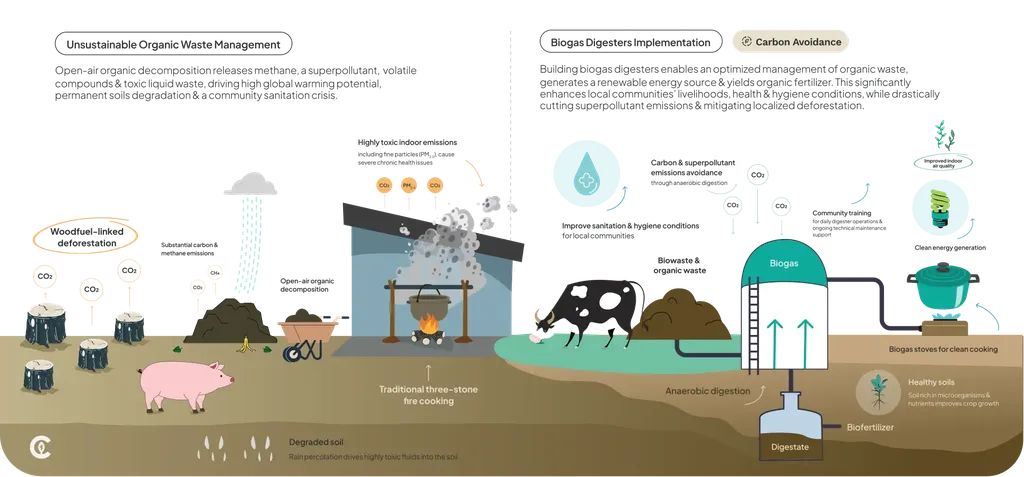
Household biogas digesters have long been hailed as a clean cooking solution for rural communities, offering a triple win: renewable energy, waste management, and reduced greenhouse gas emissions. Yet, despite thousands of installations worldwide, many systems lie abandoned within years. Why? According to Vhutshilo Nekhubvi, a physicist at the University of Venda in South Africa, the answer isn’t just about getting the technology into homes—it’s about keeping it running.
In a new mini-review published in *Frontiers in Sustainable Energy Policy*, Nekhubvi and colleagues argue that the real challenge begins *after* installation. “Most programs measure success by the number of digesters built,” Nekhubvi says. “But what good is a system if no one uses it—or can’t keep it running?”
The study, which synthesizes research from 2005 to 2026, identifies seven key factors that determine whether a small-scale biogas system survives long-term. At the top of the list: reliable access to feedstock. Without a steady supply of organic waste—animal manure, crop residues, or food scraps—the digester simply stops producing gas. That’s where good marketing comes in, Nekhubvi notes. “A well-designed system doesn’t just *accept* feedstock—it *creates demand* for it. People need to see value in feeding it daily.”
Water availability is another silent killer of biogas programs, especially in arid regions. Digesters need water to function, and in places where every drop counts, that can be a dealbreaker. “In dry areas, irrigation isn’t an option,” Nekhubvi explains. “So the system must be designed with local water realities in mind—or it won’t last.”
To address these gaps, the team proposes the Post-Installation Sustainability Model (PISM), a framework that treats biogas systems not as one-time installations, but as long-term energy services. Think of it like a subscription model: financing, monitoring, and maintenance must continue long after the digester is built.
For energy investors and policymakers, this shift in perspective could be transformative. Instead of chasing installation numbers, programs could focus on *uptake* and *longevity*—ensuring systems are used, maintained, and financially supported over time. That means investing in local technicians, supply chains for spare parts, and even incentives for feedstock collection.
The commercial implications are clear: biogas isn’t just a technology—it’s a service. And like any service, its value depends on reliability, not just installation. As Nekhubvi puts it: “We can’t keep treating biogas as a one-off project. It’s a relationship with the community—and it has to last.”