
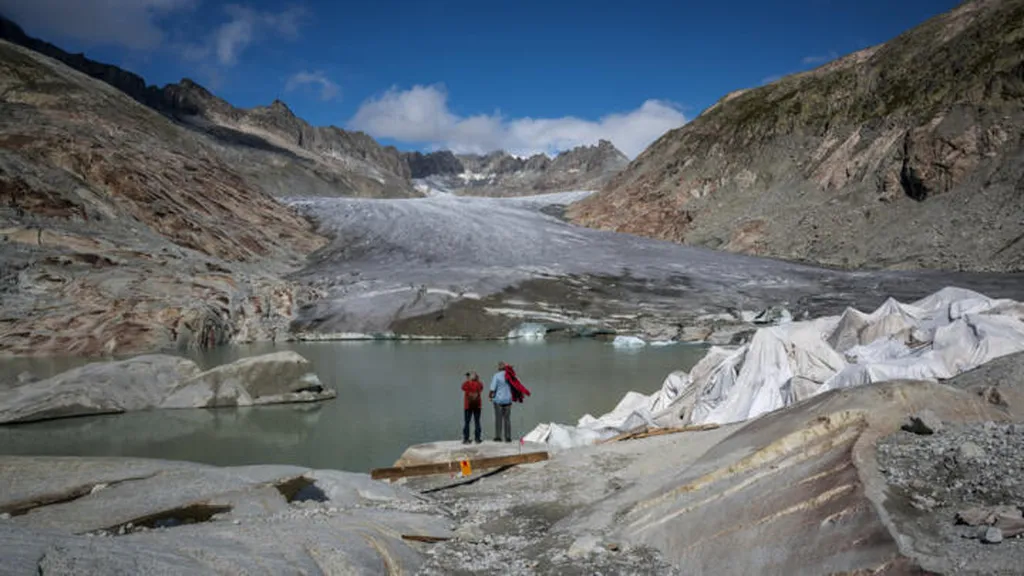
In the shadow of the Alps, where meltwater from glaciers and snowpack sustains hydropower generation and seasonal water supplies, a critical question looms: Are current hydrological models accurately capturing the sources of meltwater that power economies and ecosystems alike? A team led by Dr. J. Berg from the Institute of Geography at the University of Bern has taken a significant step toward answering this question, revealing both the promise and pitfalls of integrating global glacier models into local hydrological assessments.
The study, published in *Hydrology and Earth System Sciences* (translated: Hydrologische Prozesse und Erdsystemwissenschaften), focuses on 14 glaciated headwater catchments in Switzerland—a region where hydropower accounts for over 50% of electricity production. The research couples the HBV hydrological model (implemented within the Raven modeling framework) with the Global Glacier Evolution Model (GloGEM), while also incorporating a snow redistribution scheme to refine how snow accumulates and melts across mountainous terrain.
One of the key findings underscores a persistent challenge in hydrological modeling: parameter equifinality, where different model configurations produce similarly plausible results despite underlying uncertainties. “Within a single model configuration, glacier melt contributions can vary by more than a factor of three among the best-performing parameter sets,” Berg and colleagues note. This variability is particularly pronounced in catchments with limited glacier coverage, where melt estimates can swing by up to an order of magnitude. Such discrepancies are not merely academic—they carry real-world implications for water resource planning, particularly in energy sectors reliant on predictable meltwater inflows.
The study highlights a troubling compensatory mechanism in uncoupled models: to offset biases in precipitation forcing data, some models simulate glacier melt rates that exceed observed values by factors of 2–3. This compensatory error could lead to overestimations of available water in future climate scenarios, where melt dynamics are expected to shift dramatically. As Berg explains, “Coupling the HBV model with GloGEM produces glacier melt consistent with observations and substantially improves identifiability of both glacier and snowmelt contributions.”
For the energy sector, the implications are clear. Hydropower operators and grid managers depend on accurate forecasts of seasonal water availability to optimize reservoir operations and energy dispatch. Models that fail to correctly partition snowmelt from glacier melt risk misallocating water resources, potentially leading to either shortages during critical demand periods or inefficient spillages during high-flow seasons. The integration of glacier-specific constraints, such as those provided by GloGEM, offers a path forward by grounding melt estimates in geodetic mass balance observations—data derived from satellite measurements of glacier volume changes.
While the coupled HBV-GloGEM approach shows promise, it does come with trade-offs. Streamflow performance metrics were lower in the coupled setup compared to uncoupled configurations. However, the trade-off is justified by the elimination of compensatory errors that could undermine long-term projections. As climate change accelerates glacier retreat and alters snowmelt timing, models that prioritize physical realism over short-term performance may prove more reliable for infrastructure planning and policy-making.
Looking ahead, the researchers suggest that integrating additional observational constraints—such as snow water equivalent data—could further refine melt contribution estimates. For industries like hydropower, where water is both a raw material and a strategic resource, such advancements are not just academic—they are essential for building resilience in an uncertain future.