
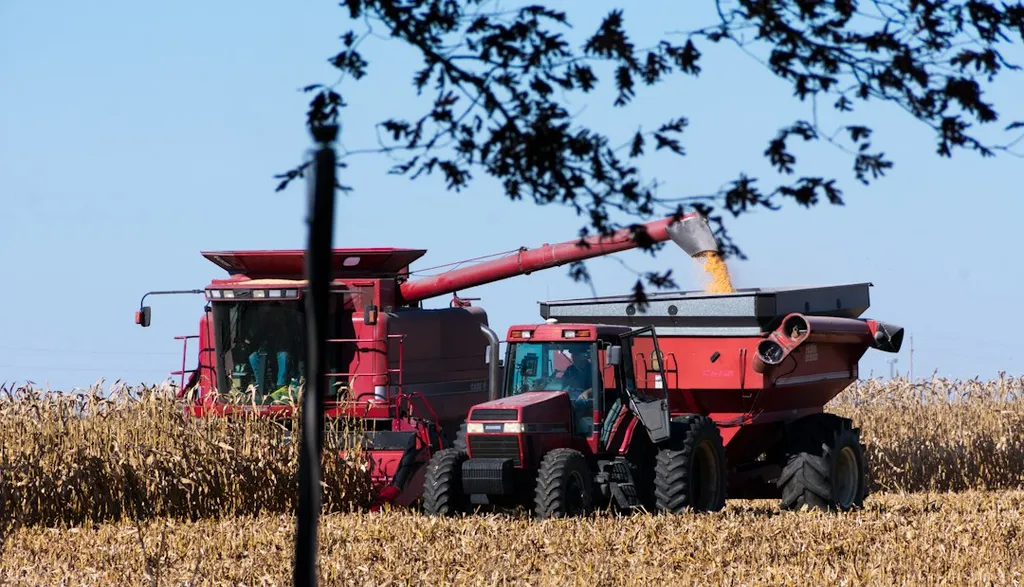
In the heart of Illinois’ corn and soybean belt, where precision agriculture meets climate ambition, a team led by Ziqi Qin at the University of Illinois Urbana-Champaign has uncovered a critical gap in how we measure the carbon footprint of biofuel feedstocks. Their findings, published in *GCB Bioenergy* (formerly *Global Change Biology Bioenergy*), don’t just refine a scientific model—they redefine how energy producers, policymakers, and farmers can quantify—and ultimately reduce—the greenhouse gas emissions tied to growing the crops that power our renewable fuels.
Qin and colleagues focused on the “cradle-to-farmgate” segment of biofuel carbon intensity (CI)—essentially the emissions from planting to harvest, before the crop even leaves the field. This stage is heavily influenced by on-farm decisions like fertilizer use, tillage practices, and crop selection, yet it has long been shrouded in uncertainty. “We found that the biggest unknowns weren’t in the soil or the weather,” says Qin, “but in the plants themselves—traits like root depth, nitrogen uptake efficiency, and photosynthetic capacity.” These subtle differences can swing a field’s CI by 30% or more, making blanket regional estimates dangerously imprecise.
The team used a powerful combination: a process-based ecosystem model (ecosys) paired with a life cycle assessment tool (GREET R&D FD-CIC) to simulate real-world conditions across 1,000+ plausible scenarios. By running a Monte Carlo analysis—essentially rolling the dice on soil types, management practices, and plant traits—they mapped out which variables most distorted CI estimates. For corn, nitrous oxide emissions from fertilizer dominated the uncertainty. For soybeans, it was changes in soil organic carbon (SOC), the slow but steady reservoir of stored CO₂ in the earth.
What makes this study groundbreaking isn’t just the diagnosis—it’s the cure. Qin’s group demonstrated that integrating real-world data—from tower-based greenhouse gas sensors to satellite imagery—can dramatically tighten those uncertainty bounds. “We used crop yield and photosynthesis data to calibrate the model, and added details like cover crop use and tillage methods,” Qin explains. “By fusing observations with mechanistic modeling, we cut uncertainty in half.” That kind of precision isn’t just academic. For energy producers navigating low-carbon fuel standards or carbon credit markets, it means finally being able to distinguish a truly low-CI field from one that only looks good on paper.
The commercial implications are immediate. Biofuel blenders and producers operating under regulations like California’s Low Carbon Fuel Standard or the EU’s Renewable Energy Directive need defensible, field-level CI data to qualify for credits and avoid penalties. A 50% reduction in uncertainty could mean the difference between qualifying a feedstock batch or losing it to a competitor with cleaner data. It also opens the door to dynamic, real-time CI reporting—where farmers and aggregators could adjust practices mid-season and see instant feedback on their carbon impact, unlocking premium pricing for verified low-emission crops.
Looking ahead, the model-data fusion approach could scale far beyond Illinois. Remote sensing platforms like Sentinel-2 or Landsat already monitor global croplands daily. If paired with AI-driven parameter calibration, this framework could deliver field-level CI estimates across entire continents—empowering traders, insurers, and regulators with the granularity they need to build transparent, efficient carbon markets.
As Qin puts it: “We’re not just measuring uncertainty—we’re designing a system to shrink it.” In an energy transition racing against the climate clock, that precision might be the most valuable crop of all.