
In the quiet, unglamorous world of groundwater monitoring, a breakthrough is quietly reshaping how industries and governments understand one of Earth’s most vital yet overlooked resources. The Global Gravity-based Groundwater Product (G3P), developed by a team led by Andreas Güntner at the GFZ Helmholtz Centre for Geosciences in Potsdam, Germany, is the first of its kind—a global dataset that tracks groundwater storage variations with unprecedented precision. Published in *Earth System Science Data* (or *Daten der Erdsystemforschung*), this innovation isn’t just a scientific milestone; it’s a potential game-changer for sectors from agriculture to energy, where water security is a growing concern.
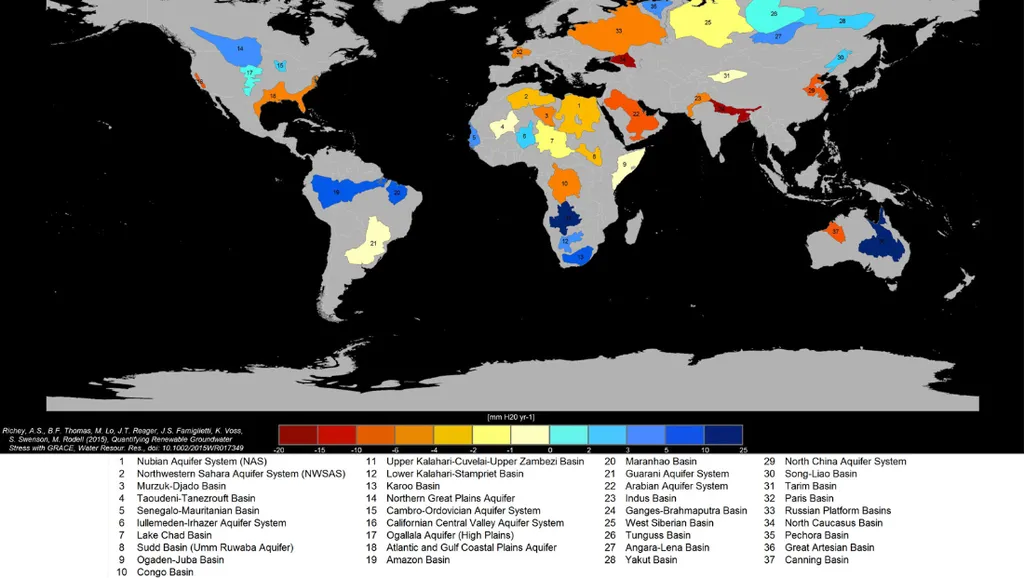
Groundwater, often hidden beneath our feet, sustains ecosystems and human civilizations alike. Yet, until now, monitoring it at a global scale has been a challenge. Traditional methods rely on piecemeal in-situ measurements or localized models, leaving vast gaps in understanding. G3P changes that by leveraging satellite gravimetry—specifically the GRACE and GRACE-FO missions—which detect subtle changes in Earth’s gravitational field caused by shifts in water mass below the surface. By subtracting other water storage components like soil moisture and glacier mass, the team isolates groundwater’s footprint, offering monthly snapshots from 2002 to 2023 on a half-degree global grid.
The implications for the energy sector, in particular, could be profound. As industries increasingly face water scarcity and regulatory pressures, access to reliable groundwater data becomes critical. “For the first time, we have a consistent, global view of groundwater dynamics,” Güntner explains. “This isn’t just about academic curiosity—it’s about equipping decision-makers with the tools to manage water resources more sustainably.” For energy companies, especially those in water-intensive sectors like fracking, geothermal, or thermal power generation, this data could inform site selection, risk assessment, and long-term operational planning.
The dataset’s validation against in-situ observations in major aquifers shows promising accuracy, with moderate to high correlations in seasonal and interannual trends. Yet, Güntner and his team are quick to acknowledge limitations. Satellite gravimetry’s spatial resolution is coarse compared to localized studies, and uncertainties in auxiliary data streams (like surface water models) can propagate. Still, G3P represents a prototype for an operational global groundwater service—one that could eventually be scaled up as part of the Copernicus Climate Change Service (C3S).
Looking ahead, this research could catalyze new commercial and policy applications. Energy firms might use G3P to predict water availability for drilling or cooling operations, while governments could integrate it into drought management strategies. The dataset’s open-access availability (via GFZ Data Services) ensures broad utility, democratizing a resource once reserved for specialists. As climate change intensifies water stress, tools like G3P won’t just fill gaps—they’ll redefine how industries and societies navigate the planet’s most pressing resource challenges.