
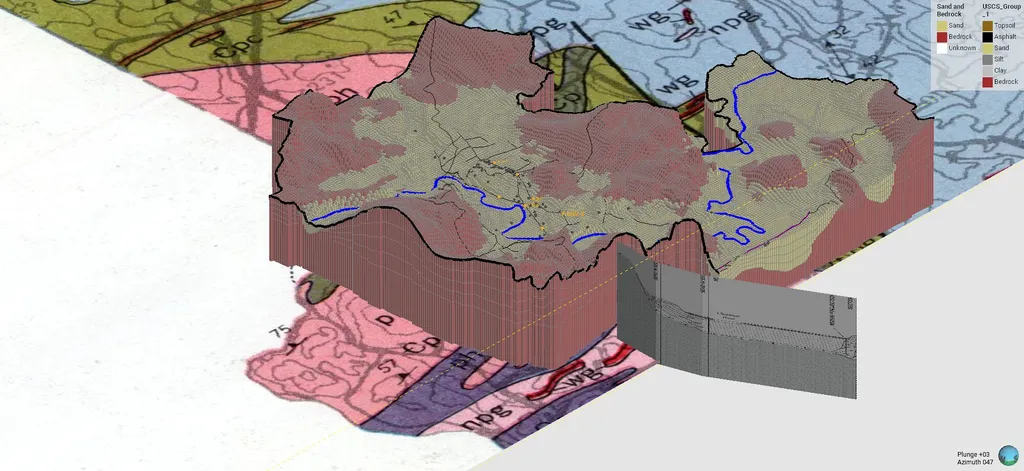
Maria Grazia Zanoni and her team at the Center Agriculture Food Environment – C3A at the University of Trento have developed a groundbreaking approach to tracking groundwater contaminants that could reshape how industries manage subsurface risks. Their hybrid model combines physics-based simulations with deep learning to predict how pollutants move through aquifers, offering a more precise tool for industries that rely on groundwater—from agriculture to energy.
Traditional methods for modeling contaminant transport have struggled with the natural complexity of aquifers, where uneven layers of rock and sediment create unpredictable pathways for pollutants. These limitations make it difficult to pinpoint contamination sources or forecast how plumes will spread—critical challenges for industries like oil and gas, mining, and even agriculture, where irrigation depends on clean groundwater.
Zanoni’s method flips the script by focusing on local concentration breakthrough curves (BTCs)—essentially, how pollutant levels change over time at specific points in an aquifer. By training a deep neural network (DNN) to learn from these curves, the model can infer transport parameters even with limited data, outperforming traditional moments-based methods. As Zanoni notes, “The DNN doesn’t just predict averages—it captures the local dynamics that ensemble statistics miss, giving us a clearer picture of where contaminants are going and how fast.”
For energy companies, this could mean faster, more accurate risk assessments when dealing with subsurface leaks or legacy contamination. Instead of relying on sparse sampling and broad estimates, operators could use this model to prioritize remediation efforts, reducing costs and environmental impact. The framework’s ability to generalize to ungauged locations—even with partial data—makes it particularly valuable for large-scale operations where monitoring is costly or incomplete.
Published in *Water Resources Research*, the study demonstrates that physics-based constraints, combined with machine learning, can bridge gaps in traditional modeling. While the method isn’t a silver bullet, it offers a practical leap forward for industries where groundwater contamination poses financial, regulatory, and reputational risks.
The next frontier? Scaling this approach for real-time monitoring, integrating it with sensor networks, and adapting it for emerging contaminants like PFAS. For now, Zanoni’s hybrid model stands as a promising tool—one that turns uncertainty into actionable insight.