
Sooyeon Han and her team at the Korea Institute of Geoscience and Mineral Resources (KIGAM) have spent years sifting through nearly 440,000 geoscience papers—every one indexed in the Web of Science from 2004 to 2023. Their goal wasn’t to read them all, but to *listen* to what the literature was saying collectively. Using cutting-edge AI tools like SciBERT and BERTopic, they mapped not just how geoscience research has grown, but how it has *shifted* in focus, language, and influence over two decades. The results reveal a field in quiet revolution—one that could reshape how energy companies explore for resources, assess risks, and plan for the future.
“What we’re seeing isn’t just incremental change,” says Han. “It’s a tectonic shift in how knowledge is produced and consumed in geoscience.” The study shows that while traditional pillars like *model*, *climate*, and *water* have remained central, new themes—especially around AI, remote sensing, and big data—have moved from the periphery to the core. Early in the 2000s, research was dominated by foundational geology and geotechnical processes. By the 2010s, climate change, paleoenvironmental reconstruction, and ecosystem dynamics took center stage. But since 2013–2014, the inflection point identified in the study, AI-driven and data-intensive methods have surged ahead, signaling a new era: *foundation model Earth science*.
For energy companies, this isn’t abstract academic news. It’s a roadmap to the future. Consider seismic interpretation: once a labor-intensive process requiring expert geologists to manually analyze 2D and 3D datasets, it’s now increasingly augmented—or even guided—by machine learning models trained on vast repositories of subsurface data. Companies that fail to integrate these tools risk falling behind in exploration efficiency and accuracy. “If you’re still relying solely on traditional geological mapping and analog models in 2024,” notes Han, “you’re not just outdated—you’re potentially overlooking hidden plays or misreading reservoir risks.”
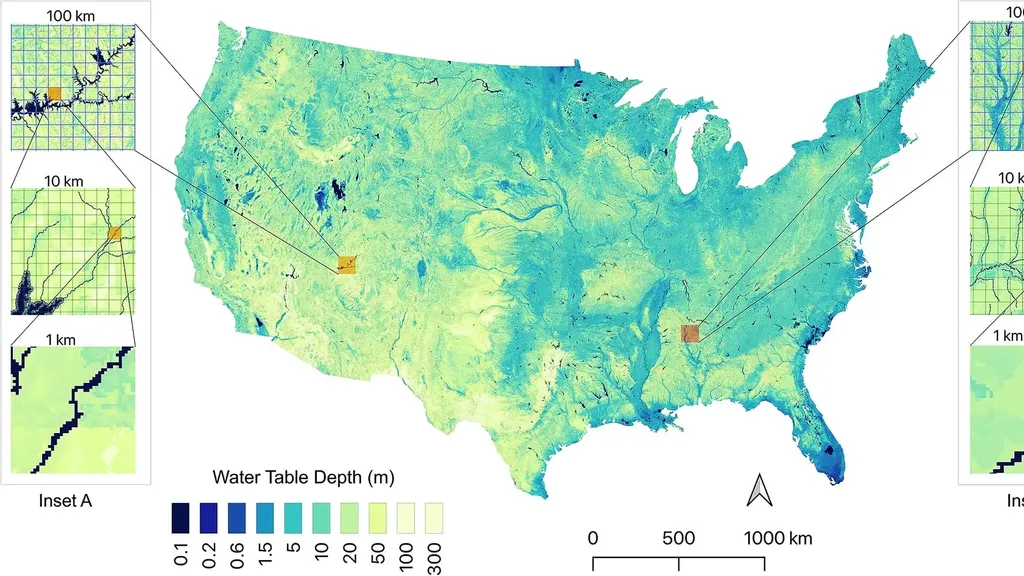
The study also highlights the growing centrality of *water* and *resource management*—themes that have quietly but steadily gained network centrality. With water scarcity and sustainable extraction becoming critical to energy operations, geoscience isn’t just about finding oil or gas anymore. It’s about understanding the full hydrological cycle, from aquifer dynamics to brine disposal, and modeling how resource extraction interacts with local ecosystems. “Geoscience today is as much about stewardship as it is about discovery,” says Han.
The implications ripple across the energy value chain. In exploration, AI-enhanced geophysical inversion can reduce dry hole risks. In production, digital twins fed by real-time sensor data help optimize recovery. In environmental compliance, predictive models assess spill risks and groundwater contamination before they happen. All of this is grounded in the same data revolution that Han’s team has quantified.
Published in the *Geoscience Data Journal* (지질과학데이터저널), this research offers more than a snapshot of the past—it’s a predictive framework. By identifying when and how thematic transitions occur, it helps industry leaders anticipate the next wave of innovation. For energy firms, that means investing not just in hardware or software, but in *knowledge infrastructure*: curated datasets, AI-ready workflows, and interdisciplinary teams that can translate raw data into actionable insight.
As foundation models like those powering large language models begin to be applied to geospatial and geophysical data, the line between “research” and “application” will blur even further. Han’s work suggests that the most successful organizations won’t be those with the best data, but those with the best *ability to evolve* with the data.
In a field once defined by rocks and maps, the future may well be written in code.