
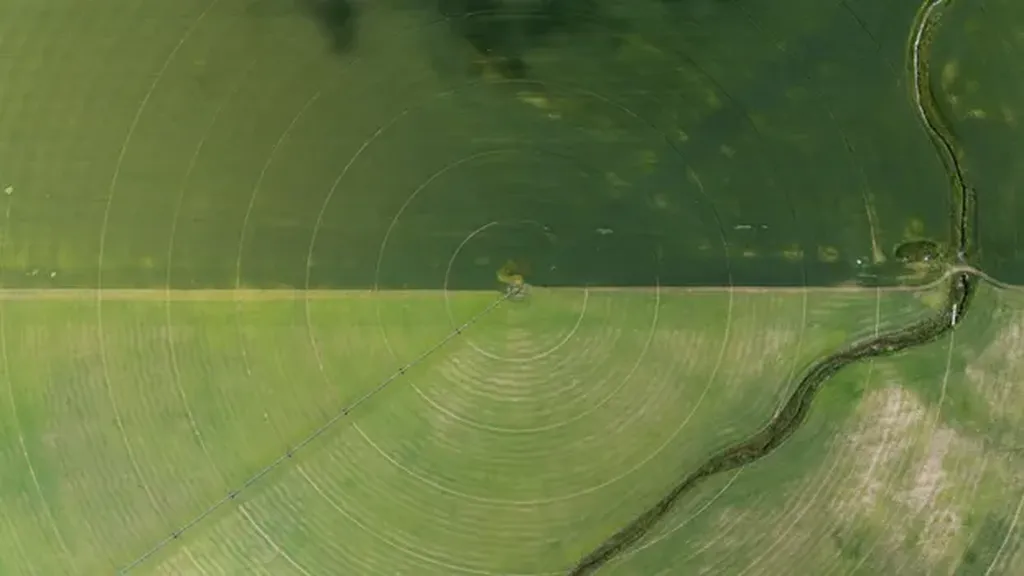
A quiet revolution is unfolding in the parched fields of global agriculture, where water—once wasted in inefficient irrigation—is being metered, monitored, and managed with unprecedented precision. At the heart of this transformation is a convergence of two digital titans: Artificial Intelligence and the Internet of Things, together forming what researchers call the Artificial Intelligence of Things (AIoT). Now, a groundbreaking systematic review published in *Next Energy* (formerly *Énergie Nouvelle*) by lead author Mira Allali and her team at the Innovation in Informatics and Engineering Laboratory (INIE LAB) in Algeria is not just mapping this landscape—it’s laying the foundation for the next generation of autonomous, sustainable, and secure irrigation systems.
Allali and her colleagues at the Laboratory of Information Processing and Telecommunication (LTIT), part of Tahri Mohammed University of Bechar, spent five years sifting through 53 peer-reviewed studies from 2020 to 2025, following the rigorous PRISMA 2020 guidelines. Their goal? To understand how AI and IoT are reshaping irrigation—and where the technology still falls short. What they found is a field dominated by cloud-based architectures and deep learning models, systems that promise real-time data collection, predictive analytics, and automated water delivery. But beneath the surface of this digital promise lies a troubling pattern: a lack of transparency in energy use, inconsistent communication protocols, and—most critically—a near-total absence of cybersecurity considerations.
“Sixty-seven point nine percent of the studies we reviewed did not address cybersecurity at all,” Allali notes. “That’s not just a gap—it’s an open door. Imagine an irrigation system hacked mid-season, valves manipulated, soil sensors spoofed. The consequences aren’t just financial; they’re existential for food security.”
The team’s response is the Smart Agriculture Integrated System Maturity (SA-ISM) model, a layered framework designed to evaluate and elevate the operational resilience, energy autonomy, and security of smart irrigation systems. Unlike earlier models that focused narrowly on yield or water savings, SA-ISM integrates cybersecurity as a core pillar—alongside energy efficiency and communication reliability.
For energy providers, this research carries a clear commercial signal: the future of smart irrigation isn’t just about conserving water—it’s about securing the digital infrastructure that controls it. As utilities and agribusinesses increasingly invest in IoT-enabled irrigation networks, the risk of cyber-physical attacks grows. A compromised valve isn’t just a leak; it’s a potential blackout in the digital grid of agriculture.
“Energy and water are inseparable,” Allali observes. “You can’t have smart water management without smart energy management. Our model shows how to do both—simultaneously.”
The implications are already rippling through the sector. Companies developing AI-driven irrigation platforms are beginning to integrate SA-ISM-like assessments into their product roadmaps. Meanwhile, utilities are eyeing these systems not just as water-saving tools, but as grid-balancing assets—irrigation networks that can throttle water flow in response to grid signals, turning farms into virtual power plants.
As climate variability intensifies and water scarcity tightens its grip, the pressure to innovate has never been greater. The work by Allali and her team offers more than a review—it offers a roadmap. One where fields don’t just grow crops, but grow smarter, safer, and more resilient—powered by intelligence, protected by design, and sustained by energy-aware innovation.
The next irrigation revolution won’t be irrigated by water alone. It will be secured, optimized, and energized by the quiet, relentless intelligence of AIoT.