
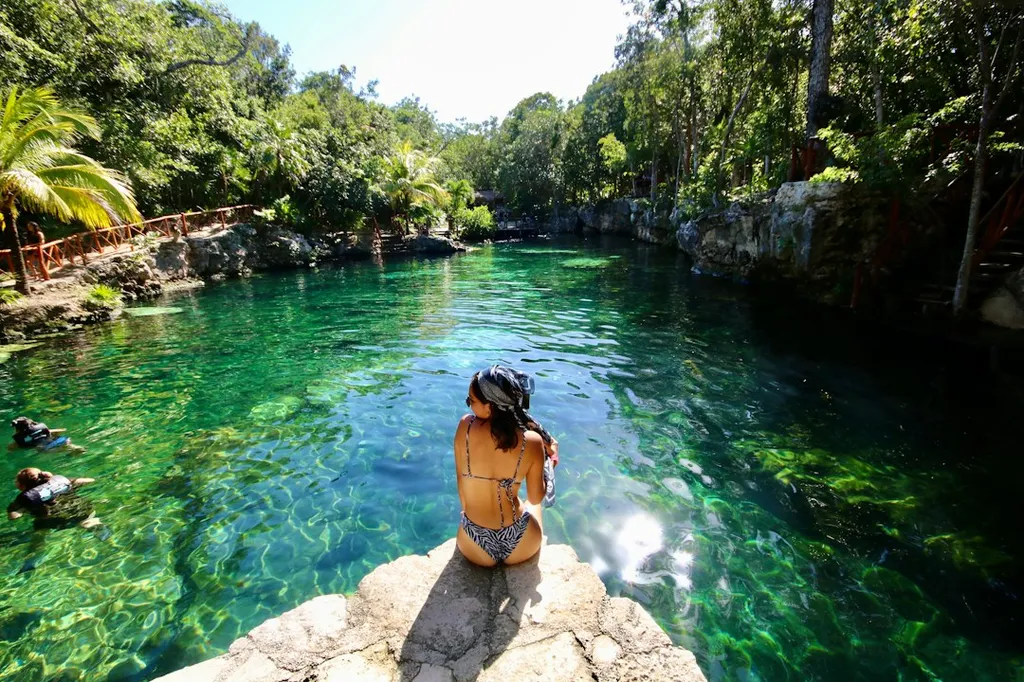
The crystal-clear waters of the Yucatán Peninsula’s cenotes have long been a magnet for tourists, but beneath their shimmering surface lies a growing concern that could ripple across industries far beyond Mexico’s shores. A new study led by Catherine Acosta of Northern Illinois University’s Department of Earth, Atmosphere and Environment reveals how sunscreen chemicals—often overlooked in environmental risk assessments—are infiltrating the region’s fragile karst aquifer, with implications for tourism, water security, and even energy infrastructure.
Acosta and her team conducted two field surveys, one in 2022 and another in 2024, analyzing water samples from heavily touristed cenotes, remote sinkholes, and public supply wells for organic UV filters like 4-methylbenzylidene camphor and butylmethoxydibenzoylmethane. What they found was both alarming and telling: even the most remote cenotes showed traces of these contaminants, suggesting a pervasive background pollution. But the real shock came at the tourist hotspot, where total hourly concentrations spiked above 700 parts per billion—far exceeding levels at low-tourism sites.
“This isn’t just about coral reefs or marine ecosystems,” Acosta explains. “When contaminants like these enter the groundwater, they don’t just stay put. They travel—through the aquifer, toward the coast, and potentially into the very water systems that support coastal industries, including energy.”
The 2024 survey took the research further, examining how extreme weather events like Hurricane Beryl could exacerbate contamination. After the storm, chemical sunscreen concentrations in a drinking water well near Puerto Morelos surged by 147.8%, while levels at the most heavily used tourist cenote rose by 360.9%. Though the sample size was limited, the trend is hard to ignore. “Hurricanes are projected to intensify under climate change,” Acosta notes. “If these storms are flushing sunscreen chemicals into the aquifer at higher rates, we’re looking at a future where water treatment systems may need to adapt—and fast.”
For industries reliant on stable water supplies—such as desalination plants, coastal power stations, or even agricultural operations—the findings underscore a critical vulnerability. As tourism in the Riviera Maya continues to boom, the pressure on local water resources will only grow. Yet the study also points to a solution: regulation. By targeting specific UV-filter ingredients, policymakers could mitigate contamination at its source, protecting both the environment and the economic engines that depend on it.
Published in *Frontiers in Water* (translated from *Fronteras en Agua*), this research is a call to action—not just for environmentalists, but for businesses and governments alike. The Yucatán Peninsula’s groundwater doesn’t just feed cenotes; it sustains livelihoods. And as climate change and tourism collide, the stakes couldn’t be higher.