
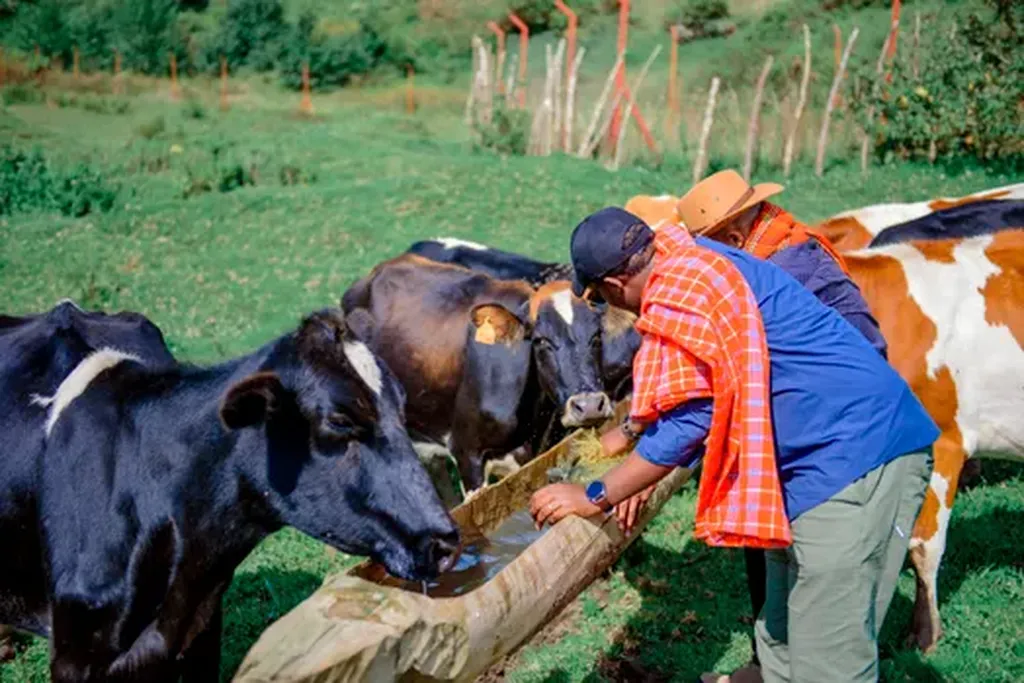
In the heart of Nairobi, Purity Ngui, a researcher at the Jomo Kenyatta University of Agriculture and Technology, has stumbled upon a discovery that could reshape how we think about water treatment—and it’s all thanks to a resource most of us overlook: cow dung. Ngui’s critical review, published in *Desalination and Water Treatment*, dives deep into the potential of cow dung-derived biochars, a carbon-rich, porous material that could offer a low-cost, sustainable solution to some of the world’s most pressing water contamination challenges.
The problem is vast. Heavy metals, dyes, pharmaceuticals, and other emerging contaminants are choking water supplies globally. Traditional treatment methods, while effective, are often energy-intensive and prohibitively expensive, especially for resource-limited regions. Enter biochar—a material that’s not just effective but also derived from an abundant, essentially free feedstock. “Cow dung is everywhere in agricultural communities,” Ngui notes. “Turning it into biochar isn’t just about waste management; it’s about creating a circular economy where nothing is wasted.”
The review highlights how cow dung biochar’s performance spans a remarkable range. For instance, raw dairy-manure biochar can adsorb 113 mg/g of lead (Pb²⁺), but with activation using phosphoric acid (H₃PO₄), that capacity skyrockets to 386.5 mg/g. Phosphorus-rich hydrochar, another variant, can remove 466.5 mg/g of lead, 339.5 mg/g of cadmium, and 264.2 mg/g of mercury. Even for stubborn contaminants like perfluorooctanoic acid (PFOA), the biochar achieves around 12 mg/g removal. These aren’t just numbers—they’re evidence that this approach could compete with conventional activated carbon, but at a fraction of the cost.
Yet, the path forward isn’t without hurdles. Unmodified cow dung biochar often suffers from low surface area and high ash content, which can limit its effectiveness. Chemical activation, while boosting performance, introduces its own challenges, including reagent costs and waste management. There’s also the issue of feedstock variability—no two batches of cow dung are identical, which can lead to inconsistent results. “We’re still in the early stages,” Ngui admits. “But the potential is undeniable.”
For the energy sector, this research could spark a new wave of innovation. Imagine power plants or agricultural operations generating their own biochar on-site, using waste streams to treat wastewater before it ever leaves the facility. The circular economy angle is particularly compelling: instead of paying to dispose of cow dung, industries could turn it into a valuable resource. The energy sector, often criticized for its environmental footprint, could find itself at the forefront of this shift.
Still, Ngui emphasizes that more work is needed. “We lack continuous-flow and regeneration data,” she says. “And there’s a critical gap in pilot- and field-scale evaluations.” Standardized testing with real wastewater, techno-economic analyses, and safe management strategies for spent biochar are all essential before this technology can scale up. But if these challenges are addressed, cow dung biochar could become a game-changer—not just for water treatment, but for how industries think about waste, energy, and sustainability.
Published in *Desalination and Water Treatment* (or *Desalinación y Tratamiento de Aguas* in Spanish), Ngui’s review is a call to action. It’s a reminder that sometimes, the most transformative solutions come not from cutting-edge labs, but from reimagining what we discard as useless. In a world where water scarcity and pollution are escalating, that’s a perspective worth exploring.