
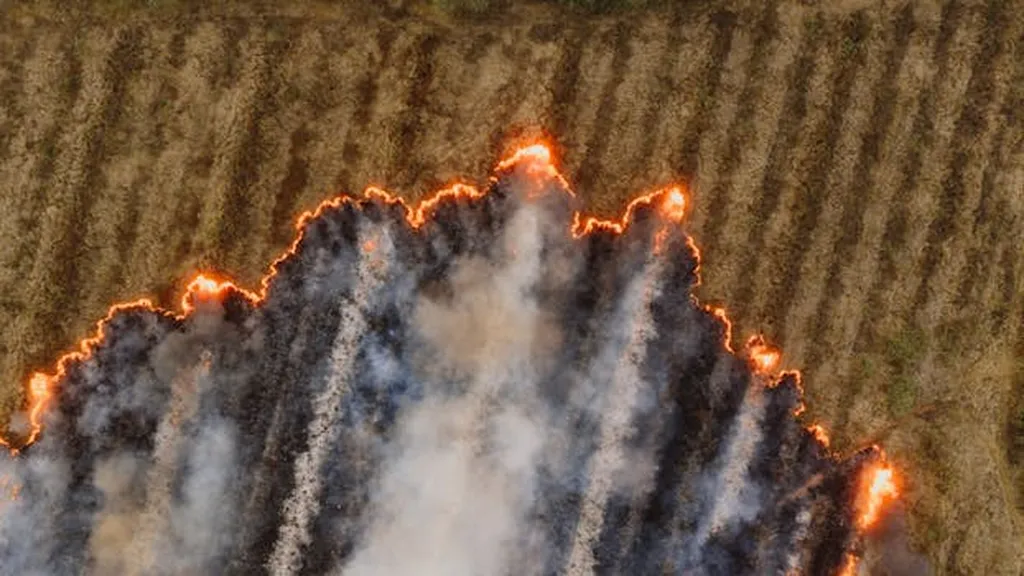
The Museum Fire’s 2019 burn scar in Coconino National Forest exposed a fundamental flaw in wildfire mitigation funding: thinning the forest to reduce fire risk creates another problem entirely—what to do with the excess wood. Jay Smith, Coconino County’s forest restoration director, still recalls the aftermath. “You had all this biomass just laying there in the forest,” he said. “It created even more of a problem once the flames encroached.” The thinning operations had left piles of logs and branches scattered among the pines, transforming a fire-prone landscape into a tinderbox. The fire hazard wasn’t just a local issue; it was a symptom of a larger breakdown in forestry waste management.
Treating forests to prevent future fires is only as effective as the disposal methods for the resulting biomass. Traditional solutions—like burning slash piles on-site—are increasingly problematic. Jay Smith acknowledges the necessity of pile burning but admits its risks have grown as temperatures rise. “With warming temperatures, pile burning becomes more risky,” he said. “We have decided it’s worth it to pay a little bit more to make sure we do get rid of the biomass.” The urgency to act is clear: in northern Colorado alone, over 140,000 bus-sized slash piles languish, waiting for disposal in a landscape already strained by beetle infestations and drought.
Enter Graphyte, an Arkansas-based startup that turns forest thinnings into dense carbon pellets and buries them underground. The company’s pitch to Coconino County officials hinged on two key advantages: relieving the biomass bottleneck and offering a climate solution. Hannah Murnen, Graphyte’s chief technology officer, describes the process as a way to “freeze” decomposition. “The site is all designed for a thousand years of durability,” she said. The method involves desiccating wood at low temperatures, compressing it into slabs, and sealing it in plastic-lined vaults to prevent moisture infiltration. In Arizona’s arid climate, this approach could sidestep the humidity problem that plagues other biomass-to-carbon technologies.
Graphyte’s first trial, Project Ponderosa, will test this model at a former cement aggregate mine on Babbitt Ranches in Flagstaff. The site, selected for its seismic stability and low flood risk, has the capacity to store the equivalent of 200,000 treated forest acres. If successful, the project could eliminate millions in transportation costs—currently, wood waste must be trucked 150 miles to processing plants in Snowflake or landscaping factories, which impose strict quality and dimensional limits. “It presented a relief valve for the vast surplus of wood fiber from forest treatment,” Smith said, “thereby allowing forest managers to speed up thinning operations to match the urgency of mitigating climate-driven wildfires.”
Yet the technology’s long-term viability remains unproven. The project’s funding hinges on carbon markets, a mechanism critics argue may not be sustainable. While burying biomass could sequester carbon indefinitely, questions linger over the durability of storage sites and the potential for leakage. Graphyte’s reliance on plastic-lined vaults and arid conditions offers some reassurance, but the approach is still in its infancy. The climate benefits are promising, but the wildfire mitigation advantages may prove more immediate.
For now, the focus is on execution. Graphyte awaits permits from the Arizona Department of Environmental Quality and plans to begin wood intake in early 2027. If it succeeds, the model could redefine how forests are managed in the era of megafires—but if it fails, the lessons from the Museum Fire’s aftermath will linger, a reminder of the costs of inaction.