
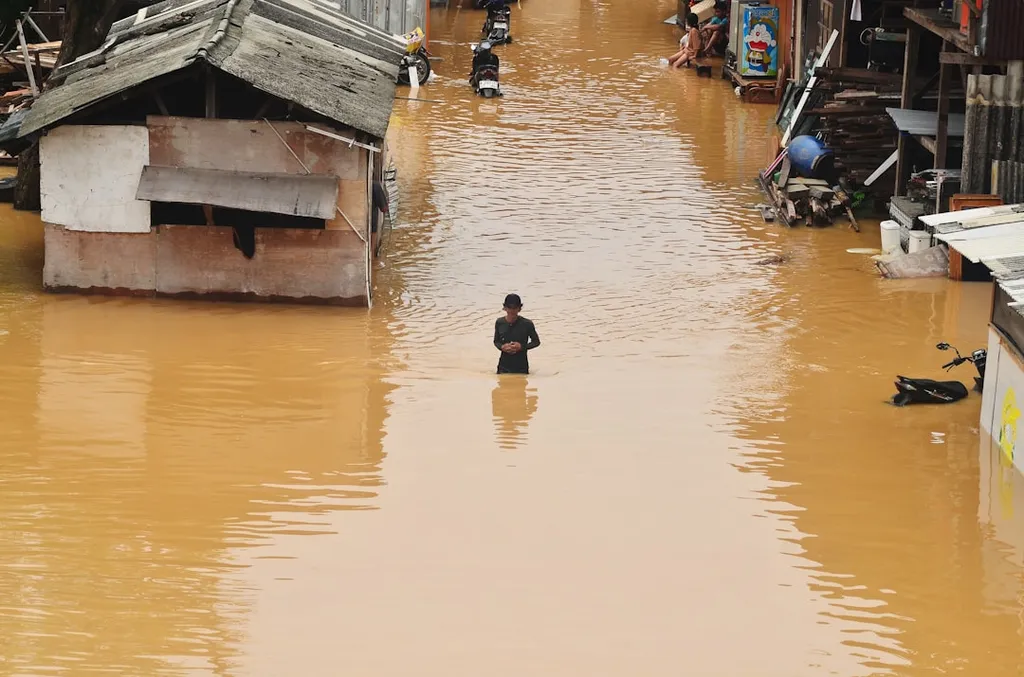
The Kemang Raya business district in South Jakarta has long grappled with pluvial flooding, a persistent challenge that disrupts commerce, strains infrastructure, and poses risks to both property and people. A recent study led by Maman Supratman, a researcher affiliated with the Bandung Institute of Technology (ITB) and the Water Resources Agency of Jakarta City, offers a data-driven pathway to mitigating these risks—not through isolated interventions, but through integrated, nature-based solutions. Published in *Nature-Based Solutions* (formerly known as *Solusi Berbasis Alam* in Indonesian), the research underscores a critical insight: infiltration wells alone are not enough.
Supratman and his team employed a sophisticated modeling approach, combining hydrological and hydraulic simulations using HEC-RAS 1D-2D, to assess flood behavior in Kemang Raya under various scenarios. Calibration against real flood depth data yielded a strong model performance (Nash-Sutcliffe Efficiency of 0.86), giving confidence in the findings. The study then evaluated flood risk across 14 Neighborhood Associations (NAs) using hazard, vulnerability, and capacity indices. Under existing conditions, 56% of the area faced high flood risk, 25% medium, and 19% low.
But the real turning point came when the team introduced Green Infrastructure (GI) and Sustainable Urban Drainage Systems (SuDS) interventions. Alone, infiltration wells—currently the only mandatory GI in Jakarta—reduced flood risk modestly. However, when combined with storage reservoirs and normalized drainage networks, the risk profile shifted dramatically. High-risk areas fell from 56% to zero, medium risk dropped to 25%, and low risk increased to 75%.
“Our findings clearly show that relying solely on infiltration wells is insufficient,” Supratman notes. “To achieve acceptable flood risk levels, we must adopt an integrated approach—combining GI and SuDS elements like retention basins, improved drainage, and permeable surfaces.”
This has significant implications for urban planners, investors, and energy stakeholders. Flooding disrupts power supply, damages electrical substations, and increases operational costs for businesses. By adopting integrated GI strategies, commercial districts like Kemang Raya can reduce downtime, protect critical infrastructure, and enhance long-term resilience. The research suggests that cities investing in multi-layered drainage systems and nature-based solutions may see not only reduced flood damage but also lower energy-related recovery costs and improved sustainability credentials—factors increasingly important for corporate ESG reporting and investor confidence.
The study’s call for policy reform aligns with global trends toward climate-adaptive urban design. Jakarta’s Water Resources and City Spatial Planning Agency can use these insights to refine flood mitigation strategies, potentially influencing infrastructure investment decisions worth millions. For energy companies operating in flood-prone urban centers, this research offers a blueprint: resilience isn’t built on single solutions, but on integrated systems that work with nature—not against it.