
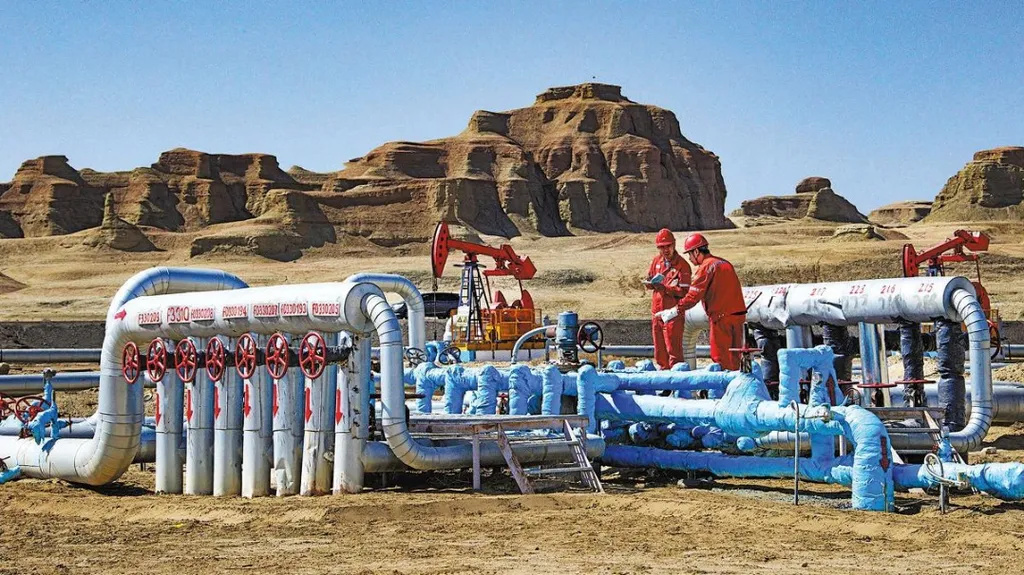
In the arid landscapes of China’s Changqing Oilfield, where the extraction of coalbed methane is a critical yet water-intensive process, a team led by PetroChina’s Liu Kaiwen has unlocked a solution that could redefine how the energy sector approaches produced water treatment. Their research, published in *Industrial Water Treatment* (Gongye shui chuli), introduces a method that not only removes calcium from produced water but also permanently sequesters CO₂—a dual benefit that aligns with both environmental and economic imperatives.
Produced water from coalbed methane wells in the region often contains staggering levels of calcium ions (up to 10,100 mg/L), rendering it nearly unusable for reuse without costly treatment. Traditional methods like chemical precipitation or ion exchange can be effective but often come with high operational costs and secondary waste streams. Liu’s team, however, turned to CO₂—a greenhouse gas—as the primary reagent. “We’re not just treating water; we’re turning a liability into an asset,” Liu explained. “By using CO₂ as a precipitant, we’re able to remove calcium while simultaneously locking away carbon in a stable mineral form.”
The process hinges on carefully controlling pH levels and CO₂ dissolution. The higher the initial pH of the produced water, the more readily CO₂ dissolves, forming carbonic acid that reacts with calcium to precipitate as calcium carbonate. The team found that optimizing aeration rates, bubble size, and temperature could drive the calcium removal efficiency to an astonishing 99.21%. At normal temperature and pressure, with a raw water pH of 11.0 and an aeration rate of 200 mL/min for just 10 minutes, the treated water’s calcium concentration dropped to levels suitable for reuse in fracturing fluids.
What makes this approach particularly compelling is its scalability and environmental upside. Unlike conventional methods that require continuous chemical inputs, CO₂ calcium removal can achieve permanent storage of carbon dioxide while generating reusable water—a critical advantage for water-scarce regions. “This isn’t just about compliance or cost savings,” Liu noted. “It’s about creating a circular system where energy extraction and environmental stewardship go hand in hand.”
For the energy sector, the implications are substantial. Coalbed methane producers, particularly in water-stressed areas, could reduce freshwater consumption while mitigating carbon emissions. The technology also aligns with global decarbonization efforts, offering a pathway to “carbon neutrality” without sacrificing operational efficiency. While further field trials are needed, the research suggests a future where produced water treatment is no longer a burden but a value-added process.
As industries worldwide seek sustainable solutions, Liu’s work stands out as a testament to innovation born from necessity. The next step? Scaling the method beyond the lab and into the field—a challenge that, if met, could set a new standard for water and carbon management in energy production.