
The semiconductor industry’s relentless push for smaller, faster, and more efficient chips hinges on one often-overlooked resource: ultra-pure water. Without it, even the most advanced fabrication plants would grind to a halt. Yet, as Liu Che and his team at Shenyang Jianzhu University reveal in their recent study published in *Gongye shui chuli* (Industrial Water Treatment), the battle against one persistent contaminant—total organic carbon (TOC)—is far from over.
TOC in electronic-grade ultra-pure water (E-UPW) isn’t just a technical nuisance; it’s a yield killer. “Every microgram per liter of organic carbon that slips through the treatment process can translate into defects on silicon wafers,” Liu explains. Current standards, both China’s GB/T 11446.1—2013 and ASTM D5127—2018, set TOC limits as low as 1–5 µg/L, but achieving this consistently remains a challenge. Traditional methods—activated carbon filtration, reverse osmosis, and polishing resins—struggle to remove low-molecular-weight and neutral organic compounds, which slip through like ghosts in the system.
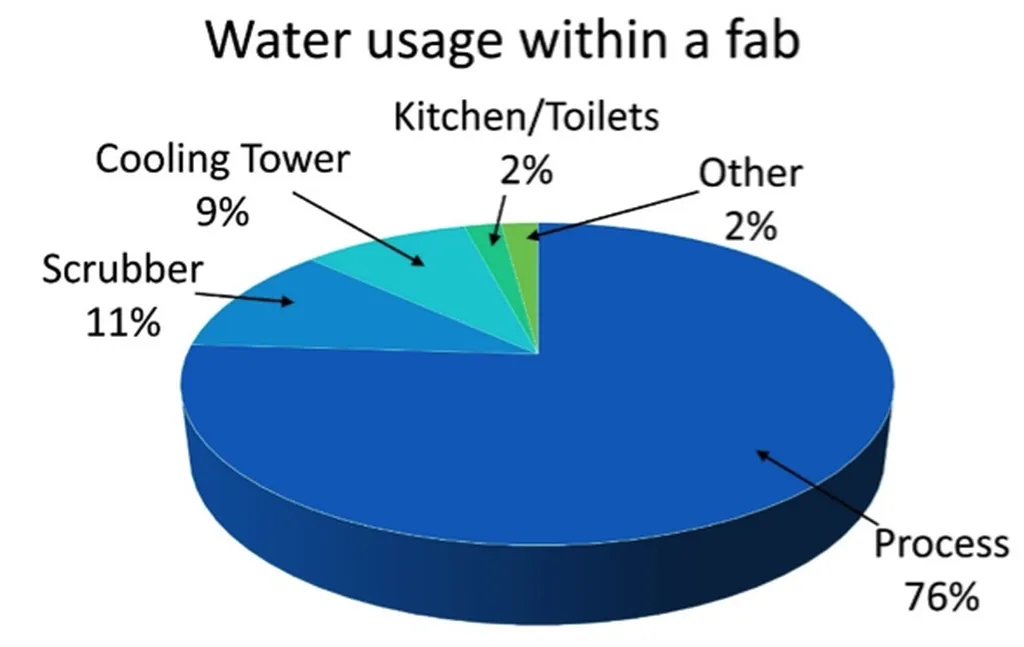
The commercial stakes are enormous. Semiconductor fabs consume millions of gallons of ultra-pure water daily, and even minor inefficiencies in TOC removal can lead to costly rework or yield losses. “The energy sector, which relies on semiconductor components for everything from power grids to renewable energy tech, can’t afford these hidden inefficiencies,” Liu notes. His research points to emerging advanced oxidation processes (AOPs)—like ozone/sodium bromide, supercritical water oxidation, and sulfate radical methods—as potential game-changers. These techniques could break down stubborn organics more effectively, but they’re not yet ready for prime time.
The study also highlights a critical gap: the need for smarter integration. “We’re still treating these processes as separate stages,” Liu says. “The future lies in coupling AOPs with conventional systems in real time, using AI-driven monitoring to adjust parameters on the fly.” Such a shift could slash energy use while improving water quality—a double win for sustainability and profitability.
For industries dependent on semiconductor innovation, Liu’s work isn’t just academic. It’s a roadmap. As fabs chase ever-tighter tolerances, the pressure to refine E-UPW treatment will only grow. The question isn’t whether these technologies will evolve—it’s how quickly.