
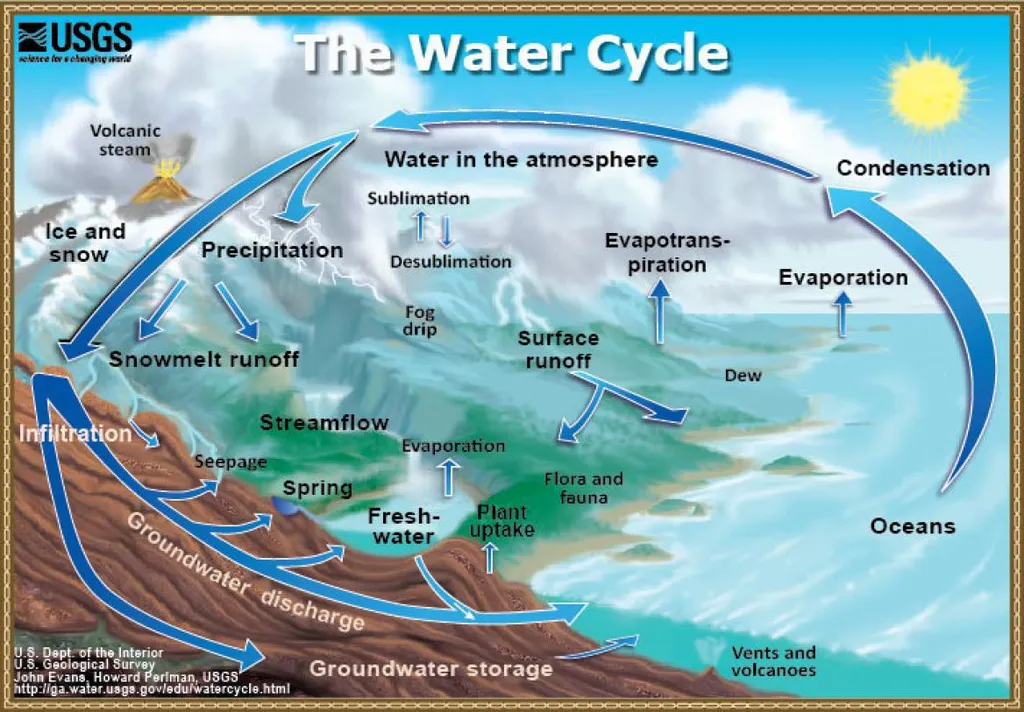
In a world where water is increasingly becoming a strategic resource, a new study led by Fuxiong Guo from the State Key Laboratory of Water Disaster Prevention at Hohai University in Nanjing offers a groundbreaking perspective on how global warming is reshaping the planet’s water cycle. Published in *Earth’s Future*, the research reveals that rising temperatures are not just altering water availability—they’re intensifying the very mechanisms that move moisture across the Earth’s surface, with profound implications for industries that depend on predictable water patterns.
Guo and his team analyzed 44 years of ERA5 reanalysis data, a high-resolution dataset widely used in climate science, to dissect how the global surface water budget responds to warming. Their findings suggest that as the planet heats up, the ocean is exporting more moisture to the atmosphere, while landmasses are receiving an increased influx of water—a process the authors describe as a “strengthened ocean-to-land moisture redistribution.” This intensification isn’t uniform, however. The study identifies distinct regional responses: subtropical and water-deficit zones are drying out due to shifting circulation patterns, while surplus and high-latitude regions are getting wetter, driven by both thermodynamic and eddy-related mechanisms.
What makes this research particularly compelling is its focus on the underlying processes. Instead of just observing changes in precipitation or evaporation, Guo’s team developed a “process-level decomposition framework” to isolate the contributions of different factors—thermodynamics, circulation, transient eddies, surface pressure, and column storage—to the overall water budget. “Circulation and transient eddies are the dominant drivers of the spatial water budget response,” Guo explains, “while thermodynamic effects, though significant, are often offset by compensating subcomponents.” This nuanced understanding could be a game-changer for industries that rely on climate models to plan for future water availability.
For the energy sector, the implications are significant. Hydropower plants, thermal power stations that depend on water for cooling, and even renewable energy projects like wind and solar farms (which require water for maintenance and manufacturing) all hinge on predictable water cycles. A shifting water budget could mean more frequent droughts in regions critical for energy production, or conversely, increased rainfall that disrupts operations. “If we can better understand how these mechanisms work, we can improve climate models and make more informed decisions about where to build infrastructure and how to manage water resources,” Guo notes.
The study also introduces a diagnostic tool that could help assess the performance of climate models and reanalyses, ensuring that future projections are as accurate as possible. As the energy industry grapples with the dual challenges of climate change and water scarcity, tools like these could prove invaluable in navigating an uncertain future.
In *Earth’s Future*, a journal focused on the sustainability of the planet and its people, this research stands out for its clarity and practical relevance. By breaking down the complex interactions that govern the water cycle, Guo and his team have provided a roadmap for how science can inform real-world decisions—especially in sectors where water is not just a resource, but a lifeline.