
Jonathan Suazo-Hernández and his team at the Facultad de Medicina Veterinaria y Agronomía, Universidad de Las Américas, Sede Concepción in Chile have uncovered a promising method for tackling cadmium pollution in water systems using an unlikely resource: blueberry pruning waste. Their study, published in *Frontiers in Environmental Science*, demonstrates how transforming agricultural byproducts into biochar could offer a sustainable and cost-effective solution for heavy metal removal in water treatment.
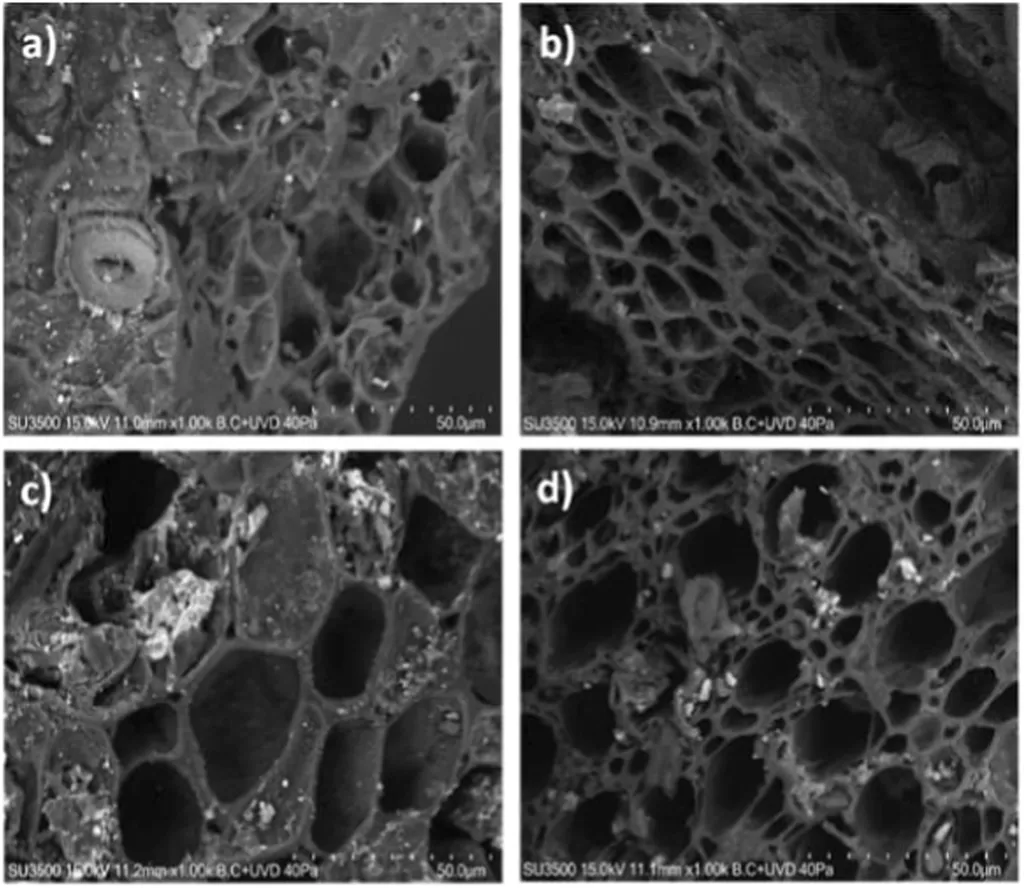
The research team explored three activation methods for biochar derived from blueberry pruning waste—chemical, biological, and biochemical—to enhance its ability to adsorb cadmium from aqueous environments. “We found that combining polystyrene plastics with vermicompost in the activation process significantly improved the biochar’s surface area and adsorption capacity,” Suazo-Hernández explained. The biochemical-activated biochar (BCbiochem) boasted a surface area of 64.2 m²/g, a tenfold increase compared to untreated biochar, and nearly doubled the cadmium adsorption capacity of other variants.
Cadmium, a toxic heavy metal, poses severe risks to aquatic life and human health, making its removal from water systems a critical challenge. Traditional methods like chemical precipitation or ion exchange can be expensive and energy-intensive. In contrast, biochar derived from agricultural waste presents a circular economy solution—repurposing what would otherwise be discarded into a functional adsorbent.
The team’s kinetic and isotherm analyses revealed that the Elovich and Langmuir models best described the adsorption process, indicating that cadmium binds to the biochar in a monolayer formation. BCbiochem stood out with an adsorption capacity of 4.13 mg/g, outperforming the other biochars tested. Even after four desorption cycles, the biologically activated biochar (BCbio) retained higher cadmium levels than the others, suggesting durability and potential for reuse.
For industries reliant on water treatment, particularly those in energy sectors where heavy metal contamination is a concern, this research could signal a shift toward more sustainable and economically viable solutions. “The beauty of this approach lies in its simplicity and scalability,” Suazo-Hernández noted. “We’re taking agricultural waste, a byproduct of blueberry farming, and turning it into a high-performing adsorbent—without the need for costly or energy-intensive processes.”
The implications extend beyond water treatment. As industries face increasing pressure to adopt circular economy practices, the study highlights the untapped potential of agricultural waste in environmental remediation. With further refinement, biochar-based solutions could reduce reliance on conventional adsorbents, lowering both costs and environmental footprints.
Published in *Frontiers in Environmental Science*, this research not only advances the field of adsorption technology but also underscores the importance of interdisciplinary innovation in addressing global challenges.