
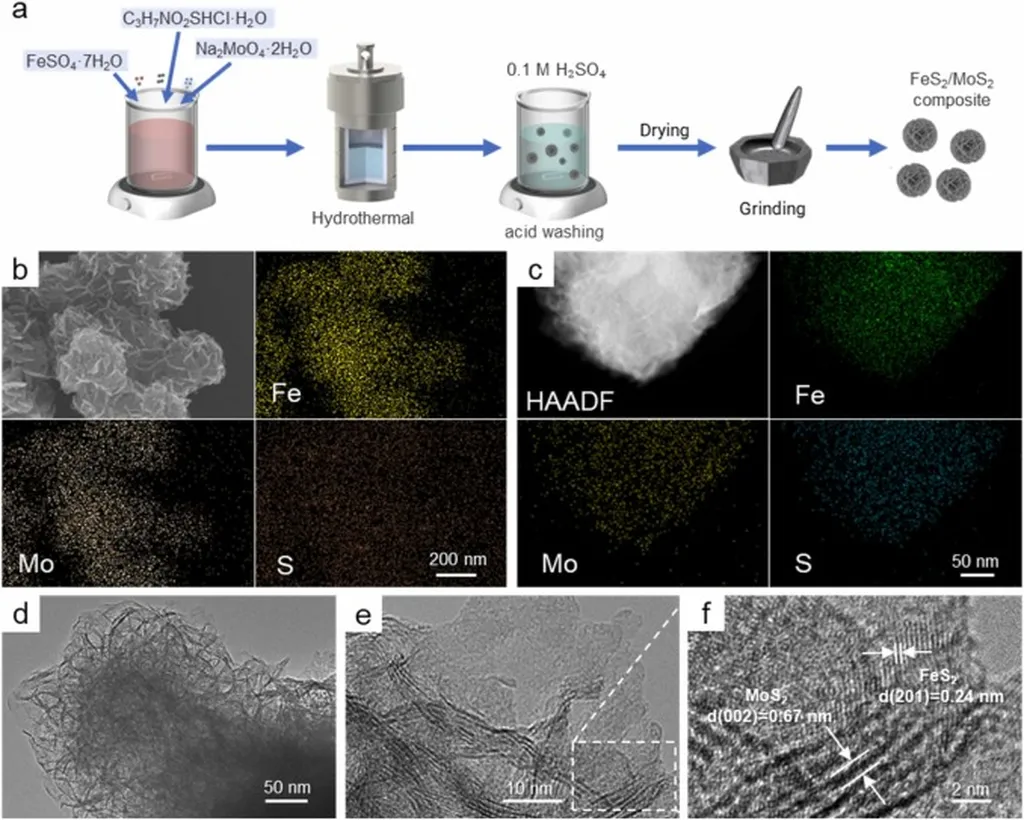
Researchers at Huaqiao University in Xiamen, China, have developed a new catalyst that could make advanced oxidation processes more practical for removing persistent organic pollutants from water. Led by Zhengyi Lu from the College of Chemical Engineering, the team designed a FeS2/MoS2 heterointerface that drives a self-sustaining charge-circulation loop, addressing longstanding challenges in catalyst stability and reactive oxygen species control.
The core innovation lies in the internal redox shuttle mechanism. “The built-in electric field enforces directional electron transfer from Mo to Fe, stabilizing continuous iron redox cycling,” Lu explains. This process autonomously regenerates dual active sites, producing both radical (•OH and SO4•−) and nonradical (singlet oxygen) species. The synergy between these pathways not only enhances pollutant degradation but also mitigates catalyst deactivation—a persistent issue in conventional systems.
In testing, the FeS2/MoS2 heterostructure rapidly removed acetaminophen and maintained 91.5% of its catalytic activity after 3,000 minutes of continuous operation across different water matrices. Such durability suggests potential for scaling in industrial wastewater treatment, where persistent pollutants often resist conventional methods.
For energy-intensive sectors like mining or petrochemicals, where wastewater treatment is a major operational cost, this technology could be transformative. The ability to sustain catalytic activity without frequent regeneration cycles reduces downtime and energy consumption, aligning with broader decarbonization goals.
Published in *Environmental Science and Ecotechnology* (translated from the Chinese title *环境科学与生态技术*), this work underscores how interfacial engineering can unlock new efficiencies in water treatment. As industries seek more robust and sustainable solutions, Lu’s team offers a compelling path forward—one where catalysts don’t just work harder, but smarter.