
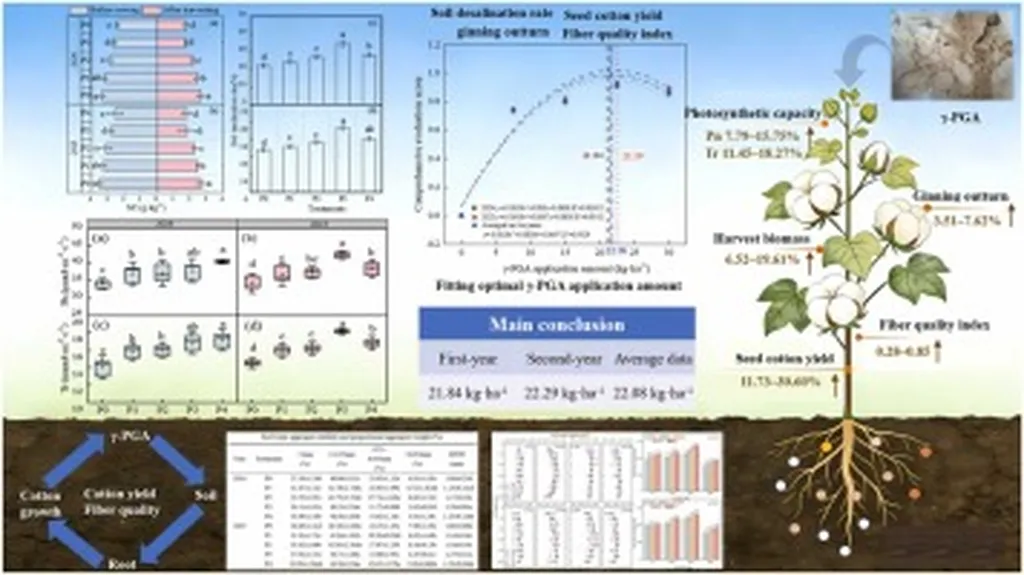
In the arid expanses of Xinjiang, where saline-alkali soils stretch as far as the eye can see, a breakthrough in agricultural science is quietly unfolding. Mengjie Liu, a researcher at Shihezi University, and her team have uncovered a way to coax more life—and more yield—from some of the world’s most stubborn farmland. Their discovery? A clever pairing of a naturally occurring soil amendment and precise irrigation could transform the economics of farming in water-scarce, salt-afflicted regions.
For decades, farmers in Xinjiang’s production and construction corps have grappled with two relentless constraints: too much salt and too little water. These aren’t just environmental challenges—they’re economic ones. Every ton of soil lost to salinization or every millimeter of irrigation water wasted chips away at profit margins in a sector already squeezed by energy costs and climate volatility. But in a two-year field trial spanning 2024–2025, Liu and her colleagues demonstrated that a synergistic strategy using γ-polyglutamic acid (γ-PGA) and optimized irrigation could reverse the trend.
γ-PGA isn’t new—it’s a biopolymer produced by certain bacteria, long studied for its water-holding and soil-stabilizing properties. But what Liu’s team found is how dramatically its effects scale when matched with the right amount of water. “We weren’t just improving soil health,” Liu explains. “We were redesigning the entire soil ecosystem—boosting microbial activity, unlocking nutrients, and ultimately, increasing cotton yield by nearly 20% over conventional practices.”
The numbers tell the story. In plots treated with 22.5 kg/ha of γ-PGA and 450 mm of irrigation (the W2P3 treatment), available phosphorus rose by over 12%, total nitrogen by nearly 30%, and total carbon by more than 70%. Enzyme activity—those invisible engines of soil fertility—skyrocketed: sucrase, a key player in sugar metabolism, jumped by 65–77%. Even more striking, microbial diversity flourished, suggesting a more resilient and adaptive soil biome.
What makes this research particularly compelling for energy and agricultural stakeholders is its potential to redefine water use efficiency. In the W2P3 plots, seed cotton yield reached an average of 6,745 kg/ha, with a water use efficiency of 12.48 kg/ha/mm—among the highest ever recorded in saline-alkali cotton systems. That’s not just good farming; it’s a strategic advantage in regions where water is metered like electricity and every drop counts toward energy-intensive desalination or deep-well pumping.
The implications ripple beyond the field. For energy companies investing in desalination plants or solar-powered irrigation, this study suggests a future where inputs are optimized, not maximized. “This isn’t about using more water or more amendment,” Liu notes. “It’s about using the right combination—smarter, leaner, and more sustainable.”
Published in *Agricultural Water Management* (known in Chinese as 《农业水管理》), the findings offer a roadmap for high-efficiency cotton production in arid saline-alkali regions. As climate change intensifies pressure on water resources and soil health, such strategies could become critical not only for profitability but for survival. The next frontier may lie in scaling these insights—testing them across larger landscapes, integrating them with precision agriculture tools, and aligning them with renewable energy-powered irrigation systems.
What’s clear is that the future of farming in harsh environments won’t be built on brute force, but on biochemical finesse. And in Xinjiang’s saline plains, a small molecule and a measured irrigation pulse may just be the start.