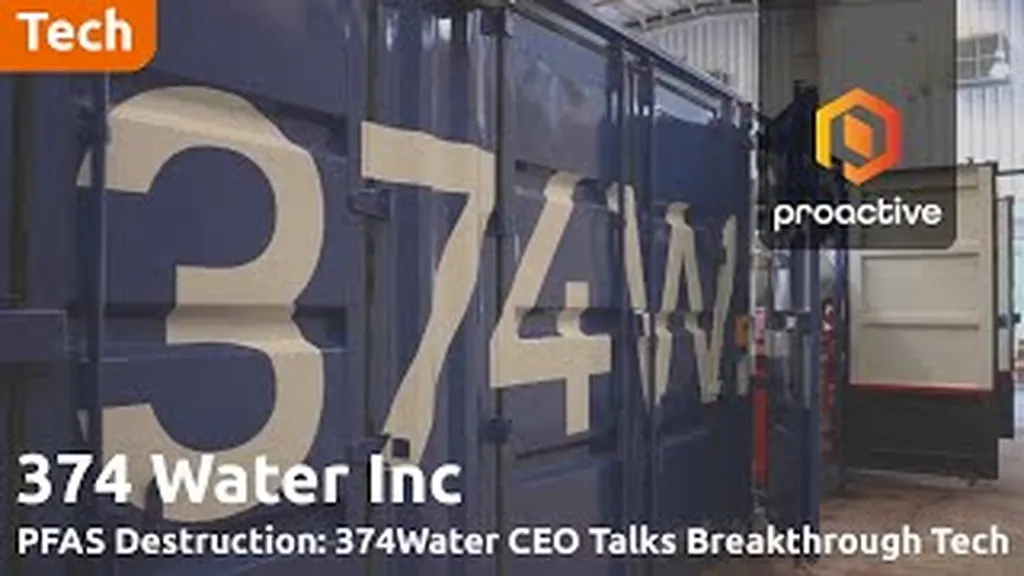
Sunny Viswanathan doesn’t mince words when he describes 374Water’s road ahead. The company’s summer conference blitz—spanning WEF Residuals in Kansas City, PFAS Forum VI in Orlando, Battelle’s Chlorinated Conference, and others—isn’t just another trade show circuit. It’s a deliberate push to shift the narrative from promise to proof in front of the exact audiences that have been wrestling with the most intractable contamination challenges for years.
The technology under discussion isn’t new in concept, but its application is gaining real-world validation. AirSCWO, the company’s supercritical water oxidation system, has moved beyond pilot-stage curiosity to commercial deployments that target PFAS, 6PPD-Q, 1,4-dioxane, and other persistent organic pollutants. What’s notable isn’t just the breadth of contaminants it claims to destroy—not merely filter or concentrate—but the fact that it does so permanently, producing dischargeable water, mineral effluent, and recoverable heat. That matters in an era where utilities and regulators are increasingly unwilling to accept transfer-based solutions that merely relocate contaminants.
The upcoming presentations aren’t academic exercises. At the WEF Residuals conference, 374Water will directly address PFAS-contaminated biosolids—a compliance headache for wastewater utilities now facing stringent land application restrictions. In Orlando, the focus shifts to aqueous film-forming foam (AFFF) destruction, a priority for defense and remediation teams still cleaning up legacy contamination. At Battelle, the company will present data from U.S. Army ERDC field demonstrations, including performance metrics from the Defense Innovation Unit’s ESTCP initiative. These aren’t slide decks with placeholder data; they’re opportunities to showcase performance under real operating conditions.
Industry engagement like this reflects a broader reckoning with legacy contaminants. PFAS, in particular, has exposed the limitations of conventional treatment methods. Adsorption, filtration, and even advanced oxidation can reduce concentrations, but they don’t eliminate the problem—they often create new waste streams that require disposal or further treatment. 374Water’s pitch is simple: if destruction is the goal, supercritical water oxidation offers a path to complete mineralization, not just containment.
The commercial infrastructure appears to be aligning. Partnerships with municipalities, government agencies, and industrial operators are already in place, and the company’s conference presence suggests an effort to scale both technology deployment and organizational capacity. But scale brings its own challenges—capital intensity, regulatory hurdles, and the need for qualified operators. The coming months will test whether the field results translate into broader adoption.
For wastewater utilities staring down PFAS limits, remediation firms managing contaminated soil stockpiles, or defense contractors navigating AFFF cleanup mandates, the question isn’t theoretical. It’s operational. Can AirSCWO integrate into existing waste management flows? Does it reduce liability while meeting discharge standards? Can it operate reliably at the volumes required for municipal or industrial applications? The summer conferences are where early adopters will press for answers.
Viswanathan’s framing is telling: “We have real results, real deployments, and a real path to scale.” That’s not corporate messaging—it’s a challenge to the industry to move beyond pilots and pilot projects. The technology is there. The question is whether the market is ready to commit.