
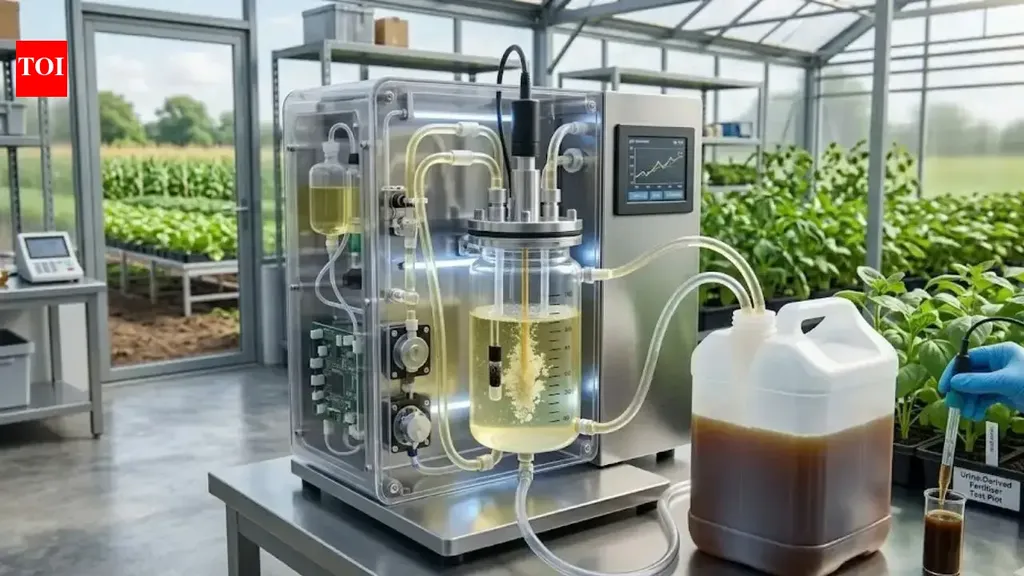
A quiet revolution is brewing in the world’s sewers, where what we flush away could soon be powering the next green revolution. New research from Hanxia Yu at the Guangdong Academy of Agricultural Sciences suggests that human urine—often overlooked as mere wastewater—holds untapped potential as a sustainable fertilizer source, offering a lifeline for both agriculture and energy-intensive industries. Published in *Plants, People, Planet* (《植物,人,星球》), the study explores how recovering nitrogen and phosphorus from urban urine could slash the environmental and economic costs of synthetic fertilizer production while mitigating pollution risks.
Yu’s team argues that diverting urine at the source—before it mingles with other wastewater—could recover up to 50% of the nitrogen and 30% of the phosphorus currently lost to treatment systems. “This isn’t just about waste management,” Yu explains. “It’s about reimagining how we produce food in densely populated cities where every nutrient counts.” For industries reliant on energy-intensive fertilizer production, this could mean significant cost savings and reduced carbon footprints.
The commercial implications are striking. Synthetic nitrogen fertilizers, a cornerstone of modern agriculture, consume roughly 2% of the world’s energy supply—energy derived largely from fossil fuels. By replacing a fraction of this demand with urine-derived nutrients, industries could cut energy use while also addressing the looming crisis of phosphorus scarcity. Phosphorus, a finite resource mined from rock, is expected to peak in availability within decades, threatening global food security.
Yet the path to implementation is fraught with challenges. Public acceptance, infrastructure costs, and regulatory hurdles remain obstacles. “We need transdisciplinary solutions,” Yu notes, “from plumbing innovations to policy frameworks that incentivize urine diversion.” Pilot projects in Sweden and South Africa have shown promise, but scaling these efforts will require buy-in from municipalities, farmers, and energy providers alike.
For the energy sector, the stakes are clear: urine diversion could reduce the carbon footprint of fertilizer production while creating new revenue streams from waste. As cities grow and fertilizer demand rises, the question isn’t whether this model will take hold—it’s how soon industries will adapt. One thing is certain: the golden opportunity in our sewers may soon be too valuable to flush away.