
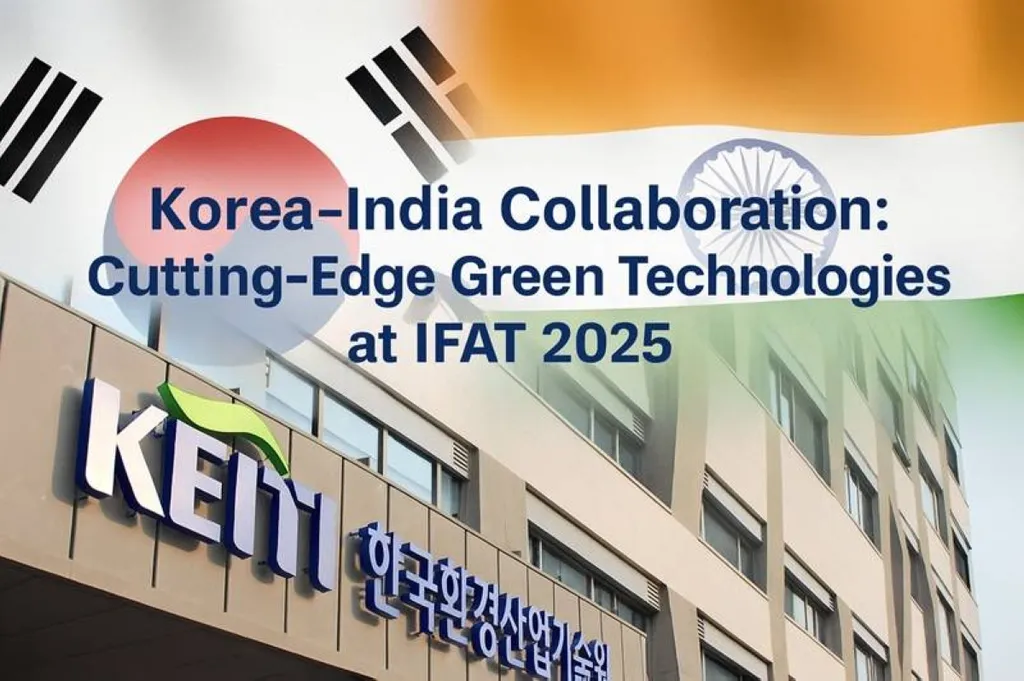
KEITI’s presence at IFAT Munich 2026 underscores a deliberate pivot from technology showcases to strategic partnerships that could reshape global water and environmental markets. The Korean Public Relations Center’s positioning at Hall B4, Booth 328, is more than logistical—it signals Seoul’s intent to bridge Asia’s clean tech leadership with Europe’s tightening regulatory and circular economy demands. With the EU’s Water Framework Directive and Green Deal driving utilities toward zero-emission operations, KEITI’s showcase arrives at a critical inflection point where compliance and efficiency are no longer competing priorities but intertwined necessities.
WINTEC GLOVIS’ superheated steam-activated carbon regeneration technology offers a case in point. Traditional thermal regeneration methods consume excessive energy and degrade carbon structure over time, but this process uses superheated steam to restore adsorption capacity without chemical additives. For European wastewater treatment plants facing PFAS contamination—where thermal destruction of activated carbon is a growing liability—this method could reduce residual waste by up to 30% while extending filter life. The technology’s relevance is immediate: Germany’s recent ban on per- and polyfluoroalkyl substances in drinking water treatment has left utilities scrambling for compliant filtration retrofits. A direct integration here could accelerate approvals under REACH regulations, positioning WINTEC GLOVIS as a drop-in solution rather than a pilot experiment.
HS Korea’s smart water management systems, meanwhile, reflect a broader shift from reactive maintenance to predictive asset governance. Their real-time monitoring platforms integrate IoT sensors, AI-driven anomaly detection, and cloud-based digital twins to optimize pipeline pressure, detect leaks within minutes, and automate regulatory reporting. In a continent where water utilities lose an estimated €3 billion annually to non-revenue water, the system’s ROI hinges on granular data integration—a challenge many European operators still grapple with due to fragmented legacy infrastructure. The question isn’t whether the technology works, but whether municipal budgets can justify the initial outlay when grant funding remains tied to traditional asset renewal programs.
NANO Co.’s DeNOx catalyst technology enters a market where industrial nitric oxide emissions are tightening under the Industrial Emissions Directive. While selective catalytic reduction (SCR) systems dominate in Europe, their reliance on vanadium-titanium catalysts has drawn scrutiny for toxic byproducts and high operational temperatures. NANO’s alternative uses a proprietary metal-organic framework that achieves 95% nitrogen oxide reduction at lower temperatures with reduced ammonia slip. Early pilot data from Korean steel plants shows a 12% drop in catalyst replacement frequency, a metric that could sway European cement and power plant operators currently locked into long-term vanadium supply contracts with Russian and Chinese suppliers.
BLUESEN’s AI-powered water quality monitoring pushes beyond compliance into predictive public health. Their platform cross-references turbidity, microbial load, and chemical signatures with weather patterns and urban runoff data to forecast contamination events before they breach treatment barriers. This anticipatory approach aligns with the WHO’s 2024 guidelines on drinking water safety, which emphasize resilience over reaction. However, adoption barriers persist: European water utilities often operate under data sovereignty laws that restrict cloud-based processing of sensitive municipal datasets. BLUESEN’s ability to localize AI processing—deploying edge computing nodes at treatment plants—could bypass these restrictions, but only if regulators accept decentralized validation protocols.
Light Bridge Co.’s green hydrogen production system offers the most provocative disruption. Positioned as a byproduct of water electrolysis powered by renewable energy, it leverages surplus grid capacity from intermittent wind and solar farms—abundant in northern Germany—to produce hydrogen without competing for potable water supplies. The system’s novelty lies in its modular design, allowing direct integration into existing wastewater treatment plants where methane digestion already produces biogas. By replacing electrolyzers’ reliance on desalinated water, it addresses one of Europe’s most contentious clean hydrogen bottlenecks: the 10 liters of freshwater required per kilogram of hydrogen produced. If scalable, this could redefine hydrogen hubs as water-neutral nodes rather than resource-intensive facilities.
The implicit tension at IFAT Munich 2026 is whether these technologies will be adopted as incremental upgrades or as systemic disruptions. Europe’s regulatory framework is accelerating toward circularity, but implementation lags behind innovation. KEITI’s pavilion serves as both a showcase and a litmus test: can Asian clean tech firms navigate Europe’s fragmented procurement cycles, stringent certification hurdles, and risk-averse utility culture? The answer may hinge on whether these companies prioritize not just technological superiority, but the bureaucratic agility to turn pilot projects into standard operating procedures. For European utilities staring down decarbonization deadlines and PFAS liabilities, the invitation is clear: witness the future, but decide quickly.